

Value Chain Mapping
Introduction
This guide explores the actors and dynamics that make reuse systems function. You will learn who the different players in the value chain are, what role each plays, and why collaboration between them is critical for scaling reuse. We will look at consumers, brands, packaging providers, retailers, logistics operators, and supporting infrastructure such as washing facilities, warehouses, hardware, and software. You will also examine the challenges and KPIs specific to each actor, and how these differ between refill and return models. By the end, you will understand how all these pieces fit together into an integrated value chain that enables reuse to be both environmentally impactful and financially sustainable.
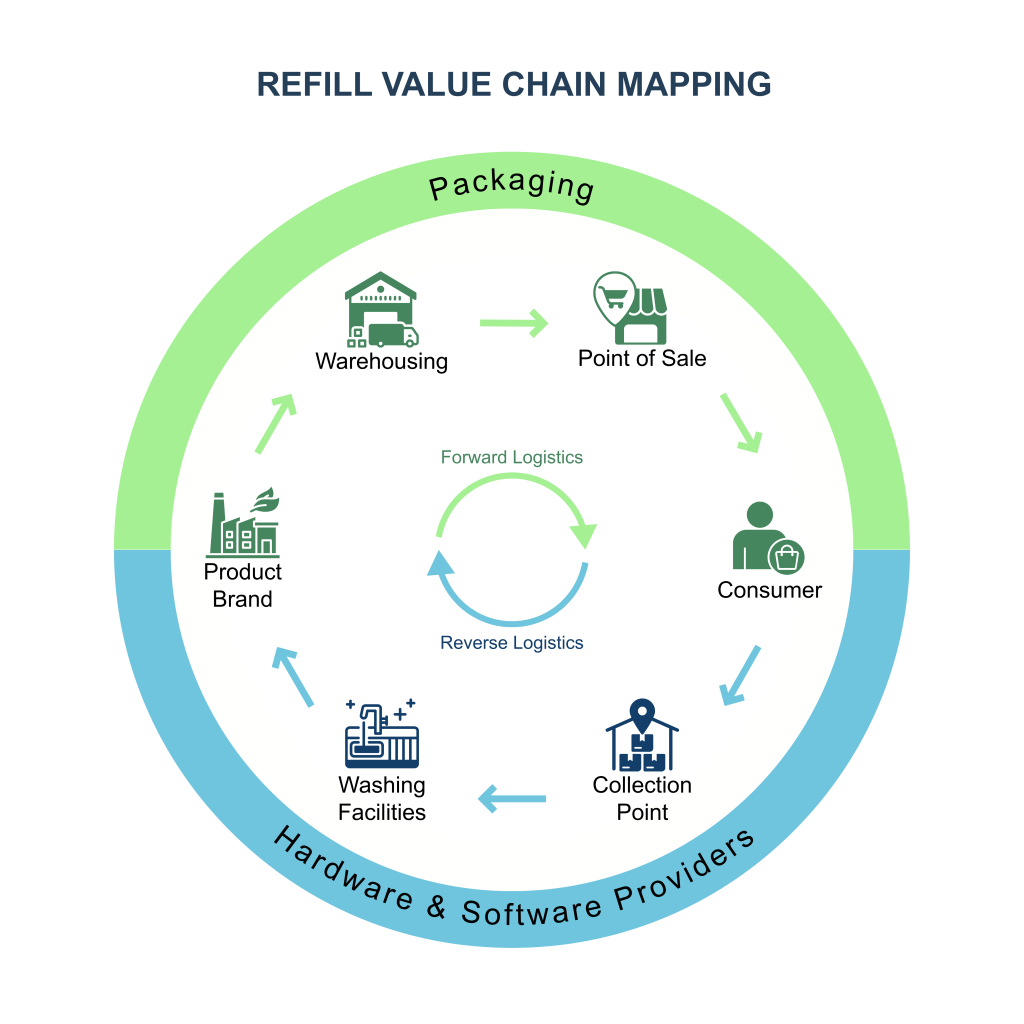
Key actors and their roles
Many actors need to come together for reuse to be successful. From sourcing products to selling to customers, ensuring proper washing and reverse logistics, an effective and financially sustainable reuse model takes coordination and planning. This section will walk you through the actors and their roles, then we will dive into more detail on these and how they differ between return and refill models as we move into the nuances of each model.
Consumer (user)
Consumers are a key actor to the success of any reuse model. Choosing reuse over single-use products requires action by consumers, for example: refilling products in their own containers, returning used containers for cleaning, participating in take-back programs. Changing consumer behavior towards reuse is THE most challenging aspect of scaling your reuse offering! Convenience is still king, and reuse models continue to struggle compared to most single-use options in this area.
But opportunities DO exist for reuse, especially given the overall trend in consumer behaviour towards more environmentally friendly options.
We can categorize consumers based on different criteria and drivers for reuse adoption – we’ll dive into this in greater detail later.
|
Consumer Segments Driving Reuse Adoption Let’s take a look at a recent Kantar Report on the UK market as an example. The report breaks down consumers into 3 categories:
· Eco Actives – Shoppers who are highly concerned about the environment and already take many actions to reduce their impact. They feel personally responsible for being sustainable, actively follow environmental topics, and show high awareness. In the UK, Eco Active households have been steadily growing, now reaching 29% compared to the global average of 22%. They represent a £37bn share of the British grocery market, making them a key growth opportunity for brands and retailers.
· Eco Considerers – Shoppers who care about the environment and take some steps to reduce their impact, but not as consistently as Eco Actives. Their biggest barriers are convenience and price. This group offers potential for growth if reuse options can match the ease and affordability of single-use products.
· Eco Dismissers – Shoppers with little or no interest in the environment who take no steps to reduce their impact. They lack awareness of environmental issues and do not believe their actions can make a difference, making them the hardest group to engage in reuse adoption. |
Product Brand
Brands offer products for sale, which can be packaged in refillable or returnable containers. Brands can play in the value chain as either B2B or B2C actors, by selling their products directly to consumers, for example through their own stores or online channels in reuse models. In a B2C offering they could partner with hardware providers and/or retailers who could in turn provide their product directly to consumers through these models.
For example, a homecare company like Alner (Indonesia, formerly Koinpack) operates a packaging-as-a-service model that facilitates fast-moving consumer goods (FMCG) businesses transitioning from single-use sachets to reusable packaging. Alner supplies reusable containers to FMCGs which are then filled with products and distributed through a network of local warungs (small neighborhood stores) and via home delivery to consumers. Customers buy, use, and then return empty packaging to retailers or Alner during the next delivery. Alner collects, cleans, sanitizes, and refills containers to meet quality standards before redistribution. This low-tech, community-embedded model leverages over 5,000 waste banks and 100,000 warungs throughout Greater Jakarta to scale a circular reuse system accessible to middle- and low-income consumers. Through its deposit-reward mechanism, Alner supports micro-entrepreneurs and incentivizes sustainable shopping habits while preventing hundreds of thousands of single-use sachet disposals annually.
Thus, a homecare company can sell liquid detergent or other products directly to consumers via their own stores or home delivery services, or partner with retailers to provide the product in reusable containers through reuse-oriented formats like vending machines or refill stations, combining consumer convenience with environmental benefits in emerging markets.
Packaging
Packaging plays a critical role in reuse models, serving not only as a container for products but also as a tool to enable the circularity of the system. Packaging must be durable, reusable, and compatible with the logistics and consumer use patterns. The size of packaging is also very relevant for operations as it will affect the point of sale, and the replenishment cost. Depending on your target audience and reuse model, the packaging needs and options will vary.
To better understand the functions and opportunities for circularity, packaging can be segmented into three levels:
- Primary (customer) packaging: This is the packaging that directly contains the product. In reuse systems, examples include a glass milk bottle, a refillable shampoo dispenser, or a reusable coffee cup. For single-use models, this would be a disposable bottle, including its label, cap, and seal.
- Secondary packaging: This groups together multiple units of primary packaging for handling and distribution. Examples include a reusable crate holding several bottles of milk or a durable box that can circulate many times. In single-use systems, this would often be a cardboard box with dividers.
- Tertiary (transit) packaging: This is used for transporting larger quantities efficiently through the supply chain. A reusable pallet with straps securing multiple crates of milk is one example; in linear systems, this is often a stretch-wrapped single-use pallet.
Over time, moving towards standardized packaging formats across these levels can unlock significant efficiencies – streamlining logistics, reducing costs, and making it easier for both businesses and consumers to participate in a truly circular system. Considering all three layers of packaging also helps to identify where the biggest environmental impacts and operational opportunities lie.
Packaging Models
If you are a brand selling products to a business for refill distribution, your packaging will typically take the form of large-volume, durable containers such as reusable kegs, tanks, jerrycans, or bulk dispensers. These are built to hold significant quantities of product that your customers can tap, portion, or repackage into smaller units for end consumers or downstream users. Your responsibility doesn’t end with the sale. You also need to manage industrial-scale washing and sanitizing containers, coordinate logistics and transport, ensure timely replenishment, and maintain product quality throughout each delivery cycle.
You may choose to add traceability features, such as printed QR codes, RFID tags, or NFC technology, to improve operational visibility and build customer trust. If you integrate a software platform or app into your logistics, traceability is usually embedded automatically.
At scale, your packaging can become part of a wider circular ecosystem. When multiple operators share standardized containers and pooled logistics, you reduce material consumption and transport emissions while cutting costs and simplifying operations. This collaborative approach makes reuse easier for you, your partners, and your customers, while delivering measurable environmental benefits.
If you are selling directly to consumers, you will have several options for packaging. For refill, consumers can bring their own container (BYOC), thereby putting the responsibility for washing and care with the consumer themselves, or there can be a take-back system for refill at home.
There are many key aspects to consider in packaging such as standardization, nesting for transportation efficiency, labeling, etc but we will go into those details later!
Point of Sales
Reuse models can be implemented in various sales channels depending on the target market, infrastructure, and business goals. The table below gives examples of different PoS options.
|
Type |
Description |
Examples |
|
Retailer |
A retailer is a business that sells goods directly to consumers in relatively small quantities for personal use rather than resale. Retailers range from specialized zero waste stores focused on sustainability and reuse models to large mainstream supermarket chains integrating refill and return initiatives. These retailers often blend traditional physical stores with digital and omnichannel retail strategies to enhance customer convenience and environmental impact reduction. |
– Zero waste stores: for example https://www.thesoapdispensary.com/, offering refill and package-free products. – Mainstream retailers: Carrefour, Tesco. – Lotus’s supermarkets in Thailand, a market leader operating over 2,300 stores nationwide, including hypermarkets, supermarkets, and convenience formats, piloting refill and return stations as part of its commitment to sustainability and advanced «New SMART Retail» initiatives combining AI and digital shopping experiences . – Zero Waste Saigon store and refill stations in Vietnam, focusing on plastic-free shopping options. |
|
Vending Machine |
Vending machines are automated dispensers providing immediate access to products without direct staff interaction. These machines can be standalone or integrated within retail environments, leveraging both low-tech and high-tech functionalities such as smart kiosks or app-connected vending solutions. They facilitate refill and reuse by dispensing products in ways that minimize packaging waste and encourage repeat customer use. |
– Ecourage: advanced vending machines deployed within retail stores across Europe, integrating technology for seamless product dispensing. – IRefill: provider of scalable low- to mid-tech vending solutions tailored to mom-and-pop stores and small retailers throughout India and neighboring markets. – Qyos smart refill kiosks operational in Jakarta, Indonesia, offering a convenient refill experience promoting sustainability. |
|
Delivery |
Delivery channels enable products, especially eligible for return and refill programs, to be shipped directly to customers’ homes. This service is typically offered by retailers, brands, or small local shops through online platforms and logistics providers, supporting convenient and sustainable consumption habits. |
– Ocado: UK-based online grocery store offering reuse and refill options for consumers. – Siklus: an Indonesian brand specializing in home-delivery of refillable household products like laundry detergent and shampoo using a pre-fill model with eco-friendly packaging. Siklus is currently active and operating online in Indonesia as of 2025, continuing to expand its market presence. |
|
Mom-pop store |
Small, locally owned shops that provide basic staples and products to their immediate communities. These shops often participate in refill and reuse initiatives as part of grassroots sustainability efforts, especially in Southeast Asia, supporting accessibility and reducing single-use packaging. |
– RefillMyBottle: online tool that maps all the places (ie: cafe, resort, museum, or shop) where refillers could walk in and fill up their bottle with clean drinkable water for free or a minimum fee.
|
|
Hotels, restaurants |
The hospitality sector significantly impacts waste generation and can substantially reduce environmental footprints by adopting refill and reuse systems. Hotels and restaurants are increasingly installing refillable soap dispensers, offering reusable take-away containers, and implementing return schemes to reduce single-use plastic waste while boosting customer loyalty and brand image. |
– WENESY: supplier of eco-friendly refillable dispensers tailored for hotels and other commercial facilities in China. – Plastic Free ASEAN Hotels Initiative: a regional campaign promoting refill and reuse practices among hotels, with participants like An Villa in Hoi An, Vietnam actively implementing sustainable hospitality solutions. |
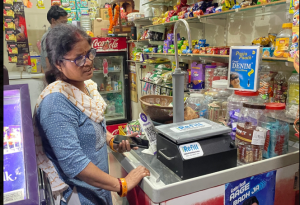
Local shop using an irefill dispenser in India. Photo credit: irefill.
Reverse logistics
Reverse logistics is the system used to collect, transport, and return used containers back through the supply chain for cleaning, refilling, or redistribution. For refill models, this is focused on the B2B models where they need to collect large bulk packages to be washed, filled, and entered back into the system. The process requires the collaboration and action from many actors including:
- Businesses who need to replace/replenish empty containers in a refill system.
- Logistics Providers who transport used containers from collection points to washing or processing centers.
- Sorting & Inspection Staff who sort containers by type and condition; check for damage or contamination.
- For B2B businesses the packaging collection and washing is the responsibility of the business.
- For B2C businesses the containers are either washed at home by the consumer using a BYOC model, or similar to the B2B model if they are providing specific packaging.
Warehousing
Warehousing acts as the central storage and distribution point for bulk goods before they are delivered to the different Points of Sale. It enables cost-effective, scalable, and reliable supply for reuse operations. Inventory management is a critical aspect of warehousing to ensure an accurate and ongoing tracking of inventory in stock at the warehouse to ensure demand is met on time, while at the same time avoiding excess stock that could expire. It’s already hard enough to change consumer behavior, don’t let this key aspect get in your way to scaling adoption!
Washing facilities
Washing facilities play a crucial role in the reuse value chain, particularly in ensuring that packaging is safely and hygienically returned to circulation. These facilities are responsible for cleaning, sanitizing, and preparing reusable containers for safe reuse in the supply chain. According to PR3, “wash” refers to a five-step process that includes the following steps in order: pre-cleaning, cleaning, rinsing, sanitizing, and drying. Check out the PR3 washing standards for detailed information.
Hardware
Hardware providers offer essential tools, systems, and equipment that enable efficient, scalable, and sustainable refill solutions. Hardware solutions offer storage, dispensing, and collection systems. Many hardware options exist in the market, the one that is best for you will depend on the product(s) you are offering, capabilities you need and volume to dispense.
While not all hardware systems are tech enabled, many providers also offer software to allow tracking and monitoring such as replenishment alerts, customer usage, contributing to the overall environmental impact data tracking.
Software / App
Software solutions can be used for both refill and return models. For refill solutions, software apps provide key metrics to enable data-driven decisions. For example, an app could allow you to have access to real time data on the products being dispensed to improve your replenishment process, consumer trends and preferences, packaging data (ie. waste avoided) which can help with reporting and compliance and much more. A software platform can also support delivery planning and services, helping to process orders and predict when refills will be needed. Both refill and return models can benefit from their apps to create customer loyalty and increase usage through loyalty programs, discounts and gamification with a larger community.
|
A just transition to reuse Reusable packaging systems will require a transformation of the ways we produce and consume products and should lead to positive environmental impacts all along the value chain. However, focusing only on the environmental impact cannot be the sole driver of this transition; new reuse systems need to define strong social ambitions as well. Moving from single use to reuse will require an employment shift that entails the creation and promotion of green and transferable skills. Read more in this recent report on a Just Transition to Reusable Packaging. |