

Go to Market Strategy – Refill models
This guide explores how to design and implement a go-to-market (GTM) strategy for return systems. We begin by outlining the essential elements of such a strategy, including identifying target markets, defining product offerings, and shaping compelling value propositions. You will explore how consumer behavior, motivations, and readiness influence adoption, and how to segment and profile your audience through market research and buyer personas. The section also covers how to assess product–market fit and viability and introduces different business models for B2B and B2C contexts. Attention is given to partnerships and collaborations with brands, retailers, municipalities, and social businesses as critical enablers for scaling. Finally, we examine the role of incentives, financial, behavioral, and regulatory, in shaping consumer and business uptake. By the end, you will understand how to integrate these elements into a coherent strategy that drives refill adoption, ensures long-term viability, and aligns with broader social and environmental objectives.
A GTM strategy defines how you introduce your product or service to market, reach your target customers, and build a competitive advantage. We will examine the key components of an effective strategy, including target market identification, product offering, and value proposition. Special attention is given to consumer behavior, as adoption of refill systems requires incentives that encourage users to participate consistently.
You will learn how to segment your market, create buyer personas, and evaluate the readiness of different customer groups. The section also highlights business model options, explores partnerships and collaborations with retailers, brands, points of sale and other key actors. Finally, we examine the role of incentives, financial, behavioral, and regulatory, in shaping consumer and business uptake.
By the end, you will understand how to integrate these elements into a coherent strategy that drives refill adoption, ensures long-term viability, and aligns with broader social and environmental objectives.
Target Market Identification
Who are you targeting to sell your product or service?
This step varies depending on your context:
- If you are an established brand, you likely already know your product line and need to evaluate which markets or customer segments are best suited for a reuse or refill model.
- If you are an entrepreneur, you may still be shaping your product concept and need to define your target market alongside product development.
- In some cases, your starting point might be the Point of Sale (PoS) or business channel—such as cafés, retailers, or delivery services and from there, you evaluate which products, margins, and consumer segments make the most sense within that channel.
Are you selling to other businesses through a B2B model, or directly to individual consumers via B2C?
Understanding their motivations is key.
Are they driven by:
- Cost savings?
- Convenience?
- Sustainability goals?
- Compliance with regulations?
Answering these questions will help you refine your product offering, marketing, and communication strategy.
- Identify the Problem you are solving
What is the pain point or need your offering addresses? For refill solutions, this might include compliance with regulations, consumer desire to reduce their own environmental footprint amongst many others.
- Segment your Market
Who are you trying to reach? Break down the broader market into specific segments based on:
- Demographics: Age, gender, income, education. Who is your target audience/user?
- Psychographics: What are their values, lifestyles, attitudes (e.g., eco-conscious consumers, zero-waste advocates).
- Behavioral Traits: Shopping habits, brand loyalty, usage frequency (e.g., frequent users of household cleaning products).
- Geographic Location: Where does your target market live? Urban vs. rural environments.
- Analyze Needs and Motivations
Dig deeper into why certain target customers or consumers would adopt your refill solution. Are they driven by sustainability, cost savings, compliance, or other? Are they early adopters or do they need more convincing through education and incentives? Is refill already the “norm” or is this a new concept?
- Evaluate Market Size & Accessibility
Assess whether your chosen segment is:
- Large enough to justify marketing spend to drive sales.
- Accessible through the channels you plan to use (online, retail, events).
- Ready to engage with the refill concept (open to behavior change, value sustainability).
- Create Buyer Personas
Develop 2–3 detailed customer profiles that represent your ideal users so you can have them in mind when developing your GTM plan.
Example personas for B2B business could include;
- Sustainability-Driven Store Owner: An Independent Organic Market selling natural food & wellness store in an urban area.
- Chain Retail Sustainability Lead: A Regional Sustainability Manager at a Mid-Size Grocery Chain with around 50 regional stores.
- Community Hub Operator: Director of Operations at a University or Co-Working Space
If you are a B2C business your personas may look like:
- Eco Emma: A 32-year-old urban professional who shops organic and wants plastic-free options.
- Budget Ben: A price-sensitive dad who’s open to refills if they save money long-term.
- Minimalist Maya: A design-conscious shopper looking for elegant, reusable packaging.
Defining your target audience sets the foundation for tailored messaging, product design, distribution channels, and promotional tactics that resonate and drive adoption. It will also help understand what technical capabilities your solution should offer based on user needs. You will also want to understand market viability factors – you can dive into this topic in more detail in the Future of Reusable Consumption report.
|
Case Study: Getting Communities into the Refill Rhythm Community refill programs succeed by actively engaging local groups, building trust, and raising awareness about the environmental and economic benefits of refill. Changing consumer habits is challenging and requires consistent communication, clear incentives, and convenient refill points in accessible locations. Collaborations among brands, retailers, and community organizations strengthen program resilience and encourage collective ownership. Tailoring solutions to local contexts and continuously adapting based on feedback are key to scaling refill adoption sustainably. Read more about the experience from TopUp truck in the link above. |
Product offering & value proposition
What product you will offer in your refill solution is key to many decisions you will make. Key elements related to your product offering to consider include:
- Product offering: what will you sell
- Location: rural or urban, at home or in store
- Market size: population of area to install
- Convenience: how easy it is for them
- Price: is this a high end or low-end offering
- Technology: will you offer products using a tech-enabled dispenser
- Packaging: will customers bring their own, or will you offer yours
- Brand: will you sell a well-known brand or a white label brand
You will also need to determine roles and responsibilities for each area to ensure a smooth flow. You may outsource some areas to experts, others you may manage in-house.
The product offering and value proposition will differ by target audience. High-end retailers may want to associate their products with high tech, cool, tech-enabled refill solutions that offer data on packaging saved, specific consumer profiles, etc while a small mom-pop shop in a rural area may only require a low-tech option that allows easy and safe dispensing of products. How you describe your value proposition to gain clients and end-users will vary therefore based on the target audience, but here are a few key areas to keep in mind.
Refill solutions offer consumers a more sustainable alternative to traditional single-use packaging by enabling them to replenish products—such as household cleaners, personal care items, food, etc—using reusable containers. But this is not enough to convince people to use refill models!
The value proposition for refill will differ based on your target market. For B2B offers, you might want to focus on eliminating unnecessary packaging waste. Helping these customers understand the potential of refill to reduce Co2 emissions and plastic waste diverted from landfill could be a strong driver as they prepare for compliance with upcoming regulations. As more and more regulations are coming into place related to packaging such as the EU regulation on PPWR and the global plastics treaty, the shift to reuse should come sooner rather than later! For developing countries or more rural locations cost might be the biggest driver, therefore speaking to how refill can increase efficiencies and reduce overall costs would be key.
The refill value proposition for retailers and brands could include increased convenience through innovative packaging formats (e.g., refill pouches, concentrates, or bulk dispensers) which allows customers to buy the exact amount of product they want.
|
Example: Sonke Sonke is a tech startup in South Africa that builds automated Refill Stations for brands and retailers enabling them to “save money and the planet”. Sonke clearly outlines the benefits for both end users and retailers on their website, making it easy to highlight the refill value. Website example in the table below:
|
The value proposition can also help brands and retailers make refill “cool” by associating consumer use of their brand with a positive environmental impact. For example, Algramo in Chile has made refill attractive and trendy through campaigns that link affordability with sustainability, such as their mobile refill tricycles and app-based loyalty rewards that resonate with younger, eco-conscious consumers.
For B2C models, it is important to remember that people buy products for physical, emotional, financial, and lifestyle-related reasons. Your refill value proposition should therefore be a combination of functionality, convenience, cost, variety, and desirability. Take another look at the Sonke example for inspiration. Depending on your target customer, the main focus will vary.
Get a better understanding of your customers through data Insights. Access user behavior, refill frequency, and popular products for improved business planning.
Ultimately, to convince the adoption of refill solutions, we must also address an essential element that drives action: cost. Refill may have a larger upfront cost for retailers or brands, as we need to implement new systems, but it has the potential to lower long-term costs. Consumers will need to play a more active role by bringing containers to refill or returning packaging for cleaning. However, in the end, this approach should offer a more economical solution, especially for those from lower-income communities who cannot afford to purchase items in large quantities. Pricing models can increase consumer action by rewarding repeated use (such as lower unit costs or subscription savings).
|
Tips from Algramo – Focus Your Efforts One of the biggest lessons from my journey with Algramo is that it’s better to focus deeply on one part of the value chain rather than trying to do everything at once. In the beginning, I was designing the packaging, building the technology, managing logistics, running marketing, and handling customer engagement in parallel. This diluted our resources, slowed down execution, and increased the risk of failure. Over time, I learned that identifying the area where you can add the most value, and partnering with experts for the rest, leads to faster results, better quality, and a more resilient business model. For example, instead of owning every step from manufacturing to reverse logistics, we partnered with specialized providers for washing and transport, while focusing our energy on system design, technology integration, and customer adoption. The takeaway: start narrow, go deep, and scale once the core works. Trying to own the entire chain from day one will stretch your capacity and increase complexity before you’re ready. |
Product/Market fit
Assessing Market Readiness
Before scaling, validate your product/market fit:
- Customer Retention Rate: >60% indicates a strong fit
- Refill Frequency: Regular repeat customers
- Customer Feedback: Positive reviews and referrals
- Competition Response: Market acceptance of the refill concept
Product Selection Criteria
Choose products with:
- High turnover rates
- Significant packaging waste
- Price-sensitive customer base
- Suitable physical properties (viscosity, shelf life)
You can try different locations, PoS, and product categories provided to test which would be the best fit as part of your pilot.
Brand
The product you offer and the positioning will also depend on if you want to partner or associate with a well-known brand or use a white-label option. Both have pros and cons for each. See more in the box below, as well as in the next section on partnerships and collaborations.
|
Branding Option |
Pros |
Cons |
|
Global Brand |
– Leverage established customer loyalty and brand awareness. |
– Higher product costs due to brand premiums. |
|
Local Brand |
– Often better attuned to regional preferences and flexibility. |
– May have limited brand recognition and customer trust. |
|
White Label |
– Usually lower product cost, enabling competitive pricing. |
– Lack of existing customer loyalty and brand awareness. |
Partnerships and collaborations
Collaboration is key to driving the scale of reuse. No matter what actor you are, you can play a role in the process, here are some examples to get you thinking.
- Collaboration between Retailers for Refill Stations: Partner with grocery stores or other retail outlets to set up convenient refill points in high-traffic areas.
- Examples:
- Tesco (UK) + Loop (TerraCycle) Customers can buy products in durable, refillable packaging and return them for cleaning and reuse.
- Lotus’s Thailand piloting refill stations in collaboration with big FMCG brands.
- Collaboration with Brands for Refill Stations.
- Examples:
- Unilever + Algramo (Chile) Algramo provided smart reusable packaging, and Unilever’s products were refilled via mobile dispensing systems.
- Unilever + Siklus (Indonesia) – delivering refill products via refill-on-wheels to households.
- Franchise and Licensing Models: Leverage established refill solution providers to scale locally by licensing or franchising their systems.
- Example:
- Vytal employs a franchise system that allows local operators to drive refill Franchise and Licensing Models: Leverage established refill solution providers to scale locally by licensing or franchising their systems.
- Example:
- Examples:
- Examples:
- Collaboration between brands and retailers
- Examples:
- Ecover + grocery stores – Ecover partners with both small and large stores to sell their products. Helps with cross-promotional activities to drive awareness and action.
- NTUC FairPrice (Singapore) partnering with various FMCG brands to pilot in-store refill stations.
- Collaboration with refill providers and local suppliers (ie: social businesses, producers) to source local products. This promotes the local economy, reducing shipping packaging, and transportation emissions.
- Example:
- Zero Waste Saigon partnering with Vietnamese refill providers to promote local cleaning and personal care products.
- Collaboration via Multi-Brand Retail Coalitions
- Examples:
- UK Refill Coalition (Marks & Spencer, Morrisons, Ocado, Waitrose) Collaborating to create standard refill infrastructure that multiple retailers and brands can use.
- RefillMyBottle network (originating in Bali, Indonesia) – coalition of cafés, hotels, and shops offering common refill points across Southeast Asia.
- Collaboration between Municipality & Refill company
- Examples:
- Case studies from the RSVP project in 5 EU cities
- Jakarta city waste management authorities collaborating with startups like Qyos and Siklus to support refill access in low-income neighborhoods.
- Examples:
- Examples:
- Example:
- Examples:
Coordinated action is needed to unlock systemic change and drive down costs, improve efficiencies and get us to a reuse revolution much faster. Check out this detailed report from EMF to learn more Unlocking a reuse revolution: scaling returnable packaging
Customer Journey
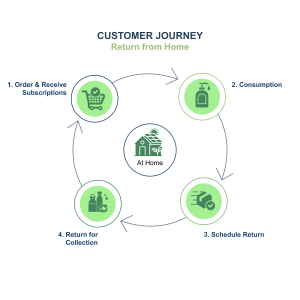
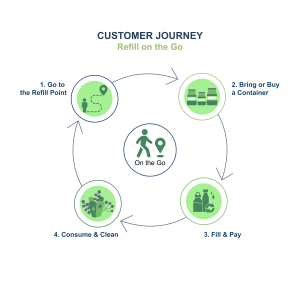
The customer journey for refill will depend on the model they use – will they refill something “at home” using a subscription service, or “on-the-go» for example, in a store? There are challenges related to customer adoption in both scenarios, but don’t worry, we will get to that in another chapter!
Below are some overarching examples of the journey for different scenarios:
Business Models Associated with Refill Solutions
Refill and return models, while related, have distinct characteristics that impact their business models, margin sources, and operational needs. Understanding these differences is fundamental to building a sustainable and profitable refill business.
Return vs Refill: Key Differences
- Return Models involve customers returning empty packaging for cleaning, sanitizing, and refilling by the company or third party. The packaging owner maintains responsibility throughout its lifecycle.
- Refill Models typically involve customers refilling their own or reusable containers themselves, either at home or on-site, requiring less centralized logistics but often higher customer engagement.
Where Do Margins Come From?
Your revenue and margin largely depend on who owns the product and/or packaging, and how value is captured:
- Owning the Product (White-label or Proprietary Brand):
You sell the product directly and control pricing, brand value, and customer relationships. This typically offers the best margins and business control. - Providing the Service:
If you only operate the refill or return service (e.g., managing logistics or equipment), margins are usually thin. This model is often insufficient alone to sustain profitability under current market conditions. - Owning the Point of Sale (PoS):
Control of the retail or dispensing location can generate additional revenue streams and enhance margins but requires investments in infrastructure and customer acquisition.
Examples of Business Models
B2B Refill Models
- Bulk suppliers servicing institutional clients (hotels, restaurants, schools) with refill concentrates or bulk products.
- Providers of refill dispensers or stations to retail chains managing the equipment and refills.
- “Reuse-as-a-service” models offering cleaning and logistics solutions to business clients.
B2C Refill Models
- Closed ecosystems such as campuses or office complexes offering refill points.
- Zero-waste or refill stores allowing customer self-service refills of household and personal care products.
- Subscription services delivering refillable products to consumers’ homes.
Recommendations
- Focus on owning the product to capture margins effectively, whether through proprietary or white-label branding.
- Service-only models should be combined with product or PoS ownership to ensure financial viability.
- Return and refill efforts can coexist, but frameworks and revenue models should reflect differences in customer experience and operational complexity.
- Leveraging partnerships, franchises, or collaborations can help scale and improve profitability.
Regardless of your offering, it can be very beneficial to clearly map out the following areas to better understand your target market:
B2B (Business to Business) Models
In B2B, you sell or provide refill-related products and services to businesses that then serve the end customer. Common models include:
- Hardware Sales: Selling refill stations or dispensing equipment directly to businesses such as grocery stores, hotels, or schools.
- Hardware Leasing: Offering dispensers or refill systems on a lease basis to reduce upfront costs for businesses.
- Bulk Product Sales: Supplying concentrated or bulk refill products (e.g., shampoo, detergent) to retailers who dispense to final consumers.
- Subscription Models: Providing bulk refill products or services on a subscription basis to businesses.
- Software Sales: Licensing or selling software for inventory management, customer insights, or dispenser monitoring to business clients.
B2C (Business to Consumer) Models
In B2C, you sell refill products or services directly to the end user, examples include:
- Subscription Services: Direct-to-consumer delivery of refill products, such as cleaning sprays or food containers.
- Direct In-Store Sales: Sales through retail outlets or zero-waste stores where consumers refill their own containers.
- Stand-Alone Kiosks or Machines: Self-service refill stations located in public places or stores where consumers can purchase refill quantities conveniently.
|
Spotlight: Salin PH Salin PH, aims to reduce the packaging waste generated by Filipino households and communities by deploying reuse, refill, and circular economy solutions for both businesses and consumers in the Philippines. One offering is Salin Swap, a reuse-as-a-service model that provides grocery shoppers with accessible and affordable household essentials in reusable containers. They do this by enabling brands and zero- waste shops the capability to offer their products in reusable containers without the hassle of maintaining them. How it works: 1. Refilling partners send products to Salin Hub 2. Customers order and receive same-day delivery by Salin Riders 3. Customers return empty containers to Salin Riders 4. Empty containers are collected and cleaned 5. Cleaned containers are sent back to refilling partners for reuse |
|
Ensuring holistic impact: a Social Business Approach Social Business is a cause-driven business. In a Social Business, the investors/owners can gradually recoup the money invested, but cannot take any dividend beyond that point. Purpose of the investment is purely to achieve one or more social objectives through the operation of the company, no personal gain is desired by the investors. The company must cover all costs and make a profit, at the same time achieve the environmental or social objective, such as providing safe drinking water, introducing renewable energy, preventing plastic pollution, reducing CO2 emission or providing health care, housing or financial services for the poor in a business way. The impact of the business on people or the environment, rather than the amount of profit made in a given period measures the success of social business. Sustainability of the company indicates that it is running as a business. The objective of the company is to achieve social goals. Nobel Peace Prize Laureate Prof. Muhammad Yunus defines the concept of Social Business by seven principles: 1. Business objective will be to overcome poverty, or one or more problems (such as education, health, technology access, and environment) which threaten people and society; not profit maximization. 2. Financial and economic sustainability 3. Investors get back their investment amount only. No dividend is given beyond investment money 4. When investment amount is paid back, company profit stays with the company for expansion and improvement 5. Gender-sensitive and environmentally conscious 6. Workforce gets market wage with better working conditions 7. Do it with joy Read more here Social Business – Yunus Environment Hub |
Incentives to Drive Adoption of Refill Solutions
To drive adoption for refill we need to incentivize our users. How can you drive adoption and use for refill solutions? Below are some examples to consider depending on your target customer’s motivation.
Incentives for Consumers:
- Points per Refill (redeemable for discounts or rewards)
- Tiered Loyalty Levels based on refill frequency
- Gamification (e.g., badges or challenges for number of refills)
- Referral Bonuses for getting others to participate
- Environmental Footprint tracking: Offer an app that helps users track their environmental footprint.
- User identify: Provide durable, stylish refill containers that elevate user experience and act as a badge of environmental commitment. This creates a physical symbol consumers can personally relate to, enhancing brand loyalty and pride. As an example of a brand that embodies environmental support and consumer identity, Patagonia is globally recognized for its strong commitment to sustainability and fostering customer connection through eco-conscious products and messaging. Drawing on such brand values can help reinforce the emotional and social benefits of refill participation.
Incentives for Retailers / B2B Partners
- Low-Cost or Free Pilot Programs: Provide machines at a discounted rate or free for a trial period to demonstrate ROI and consumer interest.
- Bulk Purchase Discounts: Reduced pricing for ordering refill product stock in larger volumes.
- Co-Financing or Lease Options: Flexible payment plans for equipment and setup to minimize capital investment.
- Customer Loyalty: Develop customer loyalty programs for those using refill options.
- Marketing Support: Co-branded promotions, POS materials, and sustainability storytelling from refill solution providers. PR and press opportunities.
|
The Algramo Business Model Algramo provided smart reusable packaging combined with dispensing and mobile refill systems that brought affordable refill products directly to consumers. Their model focused on delivering bulk products through smart containers that tracked usage, automatically reordered stock, and incentivized repeat refills. Algramo partnered with major brands like Unilever to integrate their products into the system, successfully combining sustainability with practical consumer convenience. Their franchise approach enabled local adaptation and scalability across Latin America before the company ceased operations. |