

Chapter Expectations
- Daily operations
- Responsibilities
- Bottle necks and solutions
Introduction to operations
Get ready to explore the key operational considerations for refill systems! Successful implementation of refill solutions hinges on efficient operations—from inventory management, washing and logistics to end of life management. We will outline the critical components, challenges, and best practices to help you run an effective and scalable refill system. By the end of this chapter, you should understand how to manage daily operations in refill systems, clarify key responsibilities, and anticipate bottlenecks with practical solutions.
Product sourcing
Product sourcing in refill models refers to the processes, decisions, and strategies involved in acquiring and managing the products that are later sold in refillable containers. It involves ensuring a consistent supply of products while considering sustainability, logistics, and customer demands.
Sourcing products in bulk allows refill providers to purchase large quantities at a discounted price, thereby reducing the overall cost of the product. When planning to buy in bulk you need to consider your storage space (where is this located, how does it flow into your machines, etc) and any specialized equipment required (e.g., bulk containers, dispensing systems).
The products you offer need to be aligned with the dispensing model you’ve established, expiration timeline and volume to dispense. For example, selling daily amounts of fresh milk is different from a monthly refill of laundry detergent, which differs from an at-home subscription of cleaning product tablets.
Packaging Design
When designing packaging for refill systems, several factors must be considered: durability for repeated use, ease of cleaning and sanitization, functional design for dispensing and refilling, and clear labeling for reuse instructions and product identification. Packaging should also be compatible with refill station equipment and logistics. Refill systems can offer their own standardized packaging or users can bring their own (BYOC), depending on the system set-up.
Packaging standardization is key to reducing costs along the supply chain, below are a few examples:
- Reduce space: By nesting/stacking packaging you can save space and transport higher volume.
- Compatibility: fit into existing retail spaces, filling process, etc.
- Ease of use: easy to wash container, change labels, etc.
Packaging Types for Refill Models
When setting up a refill system, it’s important to clarify what kind of packaging consumers will use. The choice affects cost, convenience, and customer experience.
- Bring Your Own Container (BYOC)
- Pros: low business cost, customer flexibility
- Cons: hygiene and compatibility challenges; customers must remember to bring and clean their own
- Specific Refillable Packaging (provided by the system)
- Unlike return, the container stays with the customer
- Often the first one is given free/low-cost, then customers buy and maintain it
- Pros: standardization, brand visibility, system integration
- Cons: higher business investment, user limited to that packaging, user upkeep responsibility
B2B vs B2C Packaging Nuances
For B2C:
- Branded containers (e.g. Lush refill soap bottles)
- BYOC (open-fill suitable, closed-fill not)
For B2B packaging, we are not talking about the consumer’s container, but rather the bulk or intermediate containers that a business uses to distribute products to retailers or refill stations, and which are then dispensed into final consumer packaging. Examples include large drums, jerrycans, tanks, or refill cartridges that slot into vending machines or in-store dispensers.
- There are several aspects you will need to understand when selling your refillable product to a business:What type of container will be used?
- Who provides the container?
- Who fills the container?
Unfortunately, no single-metric exists that can answer the question “which packaging solution should I choose to achieve the best systemic outcome?” When considering the entire system in which the packaging will participate, most solutions come with pros and cons, and there will inevitably be trade-offs[1].
We recommend reading the Ellen MacArthur Foundation report “Upstream Innovation A guide to packaging solutions” starting on page 178 to better understand how to define, identify and evaluate possible packaging solutions.
Labeling & traceability
Labeling
Labels must clearly indicate product name, ingredients, expiration or batch codes, and usage instructions, especially when containers are reused across different product types. It’s essential that labels are durable—resistant to water, handling, and repeated washing—or easily replaceable. Should be compliant to local regulations and company standards.
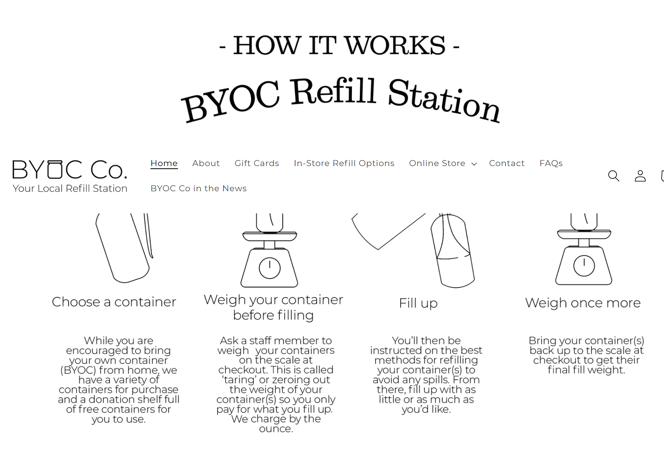
When customers bring their own refillable containers, labeling becomes more complex but remains essential for product safety, regulatory compliance, and consumer clarity. In these cases, labeling typically needs to be applied at the point of refill, often in the form of:
- Temporary stickers or printed labels – Applied during the refill process to show product name, ingredients, allergens, batch number, and fill date.
- Receipts with product info – Provided at checkout with necessary labeling details, especially for dry goods or non-perishable items.
- Digital labeling via apps or QR codes – Customers scan a station QR code to store product information digitally linked to their purchase.
(Graphic inspiration )
Traceability
For traceability, systems often use QR codes, barcodes, or RFID tags to track the container’s lifecycle, including filling, cleaning, and reuse history. This is especially important for food, personal care, and pharmaceutical products, where hygiene and regulatory compliance are paramount. Digital traceability can also support loyalty programs or deposit-return systems by linking containers to user profiles or transactions.
In the end of the day, traceability will support the data reporting and compliance to upcoming regulations, ensuring that businesses are reducing packaging waste at the amount required (or beyond!)
Examples of technologies supporting traceability:
- QR/RFID Tags
- IoT Sensors (for smart refill stations or containers)
- Cloud-based Data Management Systems
- Mobile Apps for Consumer Scanning and Engagement
- Blockchain (in high-transparency or multi-party systems)
Benefits of Traceability:
- Adhering to regulation: Tracing products can provide accurate data to ensure compliance with existing and upcoming packaging regulations.
- Health and Safety: For products like food, personal care, or cleaning supplies, tracking product batches is essential to ensure quality, recall readiness, and regulatory compliance.
- Understanding Consumer Refill Behavior: Collect data on how often consumers refill, to help optimize inventory and forecast demand. You can also gain a deeper understanding of your customers to adjust your marketing efforts accordingly.
- Reverse Logistics Oversight: In closed-loop systems (where containers are returned and refilled by the company), traceability ensures the proper return, cleaning, and reuse of packaging.
- Measuring Impact: Traceability will bring access to data, allowing for more accurate impact metrics. By knowing how much packaging you are refilling you can more accurately track things like waste diverted from landfill and the associated Co2 emission reduction.
Example: respray – use 5 times then system gives you a new one(replacement).
Quality
Quality is a cornerstone of any successful refill system. Consumers must trust that the product they purchase through a refill station is identical in quality, safety, and performance to the one they would get in traditional single-use packaging. Any inconsistency—whether in formulation, appearance, or user experience—can damage trust and slow adoption.
Ensuring quality in refill starts with the supply chain. Products should be transported, stored, and dispensed in ways that maintain their integrity. This may require bulk packaging with protective barriers, temperature control, or dedicated handling procedures. Refill stations must be designed to avoid contamination, prevent product degradation, and comply with all relevant hygiene and safety regulations.
Cleaning and maintenance protocols are equally important. Dispensers and refill equipment should be regularly cleaned, calibrated, and inspected. Staff training is key to ensuring these processes are followed consistently. For food or personal care products, compliance with local health regulations is non-negotiable, and documented cleaning schedules can be a legal requirement.
Quality also extends to the user experience. Smooth dispensing, clear labeling, and easy-to-use packaging formats reinforce trust and satisfaction. Monitoring refill data—such as batch tracking, refill frequency, and shelf life—helps identify potential issues early and allows for quick corrective action.
The goal is to make the refill experience seamless, safe, and consistent, so that customers have no reason to doubt the quality of the product they are buying. Without this assurance, even the most sustainable refill system will struggle to gain traction.
For guidance on industry standards related to washing and sanitizing reusable packaging, we recommend reviewing the PR3 Washing Standard developed by the PR3 Standards organization. This resource provides detailed, consensus-based best practices to ensure packaging is cleaned to the highest safety and quality benchmarks.
Replenishment
Replenishment in refill systems involves managing the timely restocking of bulk products, refill containers (when relevant), and associated supplies to ensure uninterrupted service. A shortage or lack of stock will bring a negative experience for customers – it is already hard enough to instill a mindset shift, don’t let a lack of stock come in the way of building your momentum! Time is especially of the essence in B2C models where customers are waiting to buy a product in that exact moment.
Replenishment includes monitoring inventory levels at refill stations or stores, forecasting demand, and coordinating with suppliers or centralized hubs. Effective replenishment requires just-in-time logistics, data tracking, and sometimes reverse logistics for collecting and cleaning. For example, a refill station in a supermarket may rely on IoT sensors to alert staff when a bulk bin is low, triggering an automated restock order.
Know who is responsible for the replenishment and train them to ensure you won’t run out of stock.
Inventory management
Managing inventory in a dispenser involves regularly monitoring product levels, ensuring proper rotation, and maintaining accurate records to trigger timely refills. This can be done manually through routine checks or automatically using sensors or smart dispensers that track usage in real time.
Each refill should be logged with batch numbers and dates to ensure traceability and compliance with safety standards. Additionally, dispensers should be cleaned and sanitized between refills, and FIFO (first-in, first-out) practices should be used to prevent product degradation or expiration.
Logistics
Logistics are crucial for refill systems because they ensure the efficient, safe, and consistent flow of products and containers throughout the reuse cycle. Without reliable logistics, issues like delayed restocking, unsanitary container handling, or bottlenecks in returns and cleaning can disrupt the system, reduce customer trust, and increase operational costs. Efficient logistics are essential to scale refill systems sustainably while keeping costs manageable and customer experience smooth.
Key components include:
- Forward logistics – Transporting bulk products to refill stations or stores, often in large dispensers or refillable packaging. It can also include transportation of your product directly to end users for at home refill models.
- Reverse logistics – Reverse logistics moves goods from customers back to the sellers or manufacturers. This includes collecting used containers for cleaning, refilling, and redistribution.
Logistics will vary depending on if you are a B2B or B2C company.
B2B models: As these are dealing with high volume refills you will want to work with less frequent, scheduled return cycles (e.g., containers collected during next delivery).
B2C models: Refill at home solutions may use last-mile delivery for transportation such as vans, bikes or couriers. For last mile transportation, incorporating a low-emissions service (ie: e-bikes) could help strengthen your value proposition to customers to bring more environmentally friendly solutions across the whole process.
It is essential to know who is responsible for your logistics. You may outsource this to a third party, or have someone manage internally depending on size and scope of your operations. You can look outside traditional logistics companies for opportunities to collaborate with an existing system or partner for more efficient logistics.
When defining roles and responsibilities, make sure to clarify:
- Who does the delivery?
- Who collects the used container?
- Who washes and under which standard?
Best Practices to increase efficiency and reduce environmental footprint
- Source locally: when possible, source products close to where you are selling to reduce transport and support local businesses.
- Optimize Packaging: Use standardized containers for products to increase the amount that can be returned at once. Avoid excess packaging such as plastic wrapping, etc in the process.
- Optimize transportation: Ensure use of efficient transportation (ie: electric vehicles, shared logistics) methods to reduce costs and environmental impact.
- Automate Processes: Implement automated systems for tracking and managing returns to increase efficiency.
- Third-Party Logistics: Consider partnering with specialists to handle reverse logistics operations effectively.
- Ongoing improvements: Assess your impact on an ongoing basis on KPIs for continuous improvements.
Warehousing
In a refill business, your warehouse is the central hub where you store bulk quantities of products before they are dispensed. For brands, you may have this on site in your location, but for reuse companies and retailers, you may rely on warehousing to source products to then refill on site, or deliver to homes. Warehousing must be aligned closely with your logistics process and replenishment timing to ensure you don’t have excess stock on site, but also are never lacking products for customers to purchase. Warehousing is essential both for B2B as well as B2C models.
Smaller B2C models might be able to store smaller amounts of products directly on site, for example in a local grocery or shop. Depending on the scale of your operations, warehousing can be managed either onsite (at the point of sale) or offsite (in a central facility), with trade-offs between space efficiency, replenishment frequency, and control over stock.
Depending on the origin of your products you may want to buy in larger or smaller amounts. For example, local products could be purchased more frequently but products sourced from farther away may be more advantageous to buy in bulk and keep at a local warehouse location.
Washing
Washing in refill systems is a critical process that ensures hygiene, safety, and product integrity, especially when containers are reused for food, personal care, or cleaning products. The process typically involves cleaning, rinsing, and sanitizing containers and dispensing equipment either on-site or at centralized washing facilities. Washing protocols must follow industry-specific standards to remove residues, prevent cross-contamination, and maintain regulatory compliance.
Depending on the system and costs, washing options could include manual washing, automated dishwashers, or industrial cleaning lines using high-temperature water, food-safe detergents, or sanitizing agents. Effective washing is essential to maintain customer trust and protect public health.
There is a lot to consider in your washing process to ensure an efficient and effective process (except for the case of BYOC, where customers are responsible for proper washing at home, and this should be clearly communicated to ensure they bring clean containers for refill). From water and energy used in the process, to the drying and stacking of packaging for reuse. You consider using a 3rd party provider to take care of your washing as part of your value chain mapping.
Recommended resources related to washing:
- PR3 offers detailed information and requirements about washing: https://www.pr3standards.org/the-pr3-standards
- Wash location mapping done for the USA and Canada Wash Hub Map — Upstream
Hardware maintenance
Hardware maintenance for refill systems is essential to ensure safety, hygiene, and consistent performance. It includes regular cleaning and sanitization of dispensers, valves, and nozzles to prevent contamination—especially important for food, personal care, and cleaning products. Routine inspections and servicing are needed to check for leaks, wear and tear, or blockages, and to calibrate dispensing mechanisms for accurate measurement. In smart systems, electronic components like sensors, touchscreens, or QR code scanners must also be maintained and updated to avoid malfunctions. A well-documented maintenance schedule helps extend equipment lifespan and maintain user trust.
What happens if your dispensing machine has a faulty part or needs repair? You will need to ensure access to spare parts, which you can do as part of your Service Level Agreement (SLA). A SLA is a formal document that defines the expected level of service between a service provider and a customer. It outlines the specific services to be delivered, the standards or performance metrics that must be met, and what happens if those standards are not achieved. This is especially important in refill models that source their hardware externally, as it will outline how long you would have to wait to repair something, if the cost is included as part of the hardware guarantee, etc. Having a clear SLA will provide clarity and avoid confusion if and when changes are needed.
|
Advice from on the ground: Rajneesh Patel, founder, iRefill Start small by testing your solution in a pilot. This will allow you to learn and adapt based off user experience and other key factors before you invest in scale. Learn from this location, what worked, what didn’t then adapt and go from there. |
Insights to Algramo Operations – Case: Unilever at Walmart ChileOne of the most significant refill projects Algramo implemented was with Unilever in Walmart Chile. In this B2B refill model, Unilever supplied Walmart with bulk product—typically in 200-litre or 60-litre containers—which Walmart staff would then use to replenish in-store refill dispensers for end consumers. This approach reduced single-use packaging, maintained product quality, and allowed consumers to purchase well-known Unilever brands in a more sustainable way. A key operational success factor was the real-time refill alerts built into the dispensers. These alerts informed store staff when the product level was running low, helping to avoid stock-outs and maintain a seamless consumer experience. However, one of the biggest challenges was not the replenishment itself, but the purchase reorder signal within Walmart’s system. For the refill station to work sustainably, Walmart needed to trigger purchase orders to Unilever at the right time—aligned with the dispenser’s usage patterns and lead times for delivery. This “reorder signal” gap became one of the most critical operational bottlenecks. When replenishment alerts from the dispenser were not fully integrated into Walmart’s purchasing workflow, delays in ordering meant dispensers could run empty, undermining customer trust and sales. The lesson: in refill systems, technical alerts must be matched with efficient supply chain and procurement processes. Without alignment between inventory data, store operations, and supplier deliveries, even well-designed refill infrastructure can fail to deliver consistent service. |
Activities or exercises
What is needed to move on to next chapter?
Map out who is responsible for each step in the refill operations
|
Areas to define |
For reflection – then define your answers to the areas below |
Who is responsible? |
|
Where will I source product(s)? |
Consider local, social businesses |
Who in my team will lead? |
|
How will I label products sold? Will I include traceability aspects? |
Where are you selling and to whom (B2B vs at home delivery) |
Who will determine labeling needs, type, traceability (and data tracking)? |
|
How will I manage forward and reverse logistics? |
Consider e-vehicles to reduce transportation emissions Design packaging for storage/transport efficiency |
Who on my team will lead? Will I hire a 3rd party to support? |
|
How will I manage inventory and replenishment? |
How often will I need to replenish stock? Is this consistent throughout the year, or are my products seasonal? Will I automate the process? You may need to change/update this as customer uptake increases. |
Who on my team will lead? Will I hire a 3rd party to support? |
|
Where will I store products to be sold? |
Can I store product on site and replenish more frequently? Does transportation of product take time (ie: from another country) |
Do I need a local warehouse? Who manages this? |
|
How will I manage washing of containers? |
What is required based off the products sold? Or will this be dependent on consumers? |
Who on my team will lead? |
|
What does the SLA outline regarding hardware maintenance? When and how do I need to |
For those using external hardware providers |
Who on my team will lead? |