

Intro to refill
Now that we’ve covered the overarching concepts of reuse it’s time to dive deep into the different systems. Based on your responses, Refill was indicated as the most applicable model for your context.
To get started, you will learn what makes refill models distinct within reuse systems, starting with their long history and cultural roots. We’ll cover two main types of refill (at home and on the go), their characteristics, and how they function in practice. We will explore the advantages and challenges of adopting refill systems, including cost, convenience, consumer behavior, and regulatory factors. You will also examine key elements for success, such as product suitability, packaging choices, and the technologies that enable safe and scalable refill operations. By the end, you will be able to identify which refill approaches are most relevant to your context and outline the first steps toward building or scaling a sustainable refill solution.
Overview of the Refill Model
Refill systems are defined by the use of a reusable container that customers refill with product, rather than replacing the entire package. Packaging is refilled by the user (not returned to the business as in the case of return), and the customer is responsible for the cleaning and maintenance of the container in the case that the B2B container is reusable as well. You have arrived at this section because your responses to the tool highlighted refill as the model most relevant for your business context, guiding you toward the approaches, opportunities, and challenges most applicable to you.
2 types of refill models
- Refill at home – where customers purchase refill packs or concentrates and refill their containers themselves at home.
- Refill on the go – where customers bring their container to a store, kiosk, or vending station to refill directly.
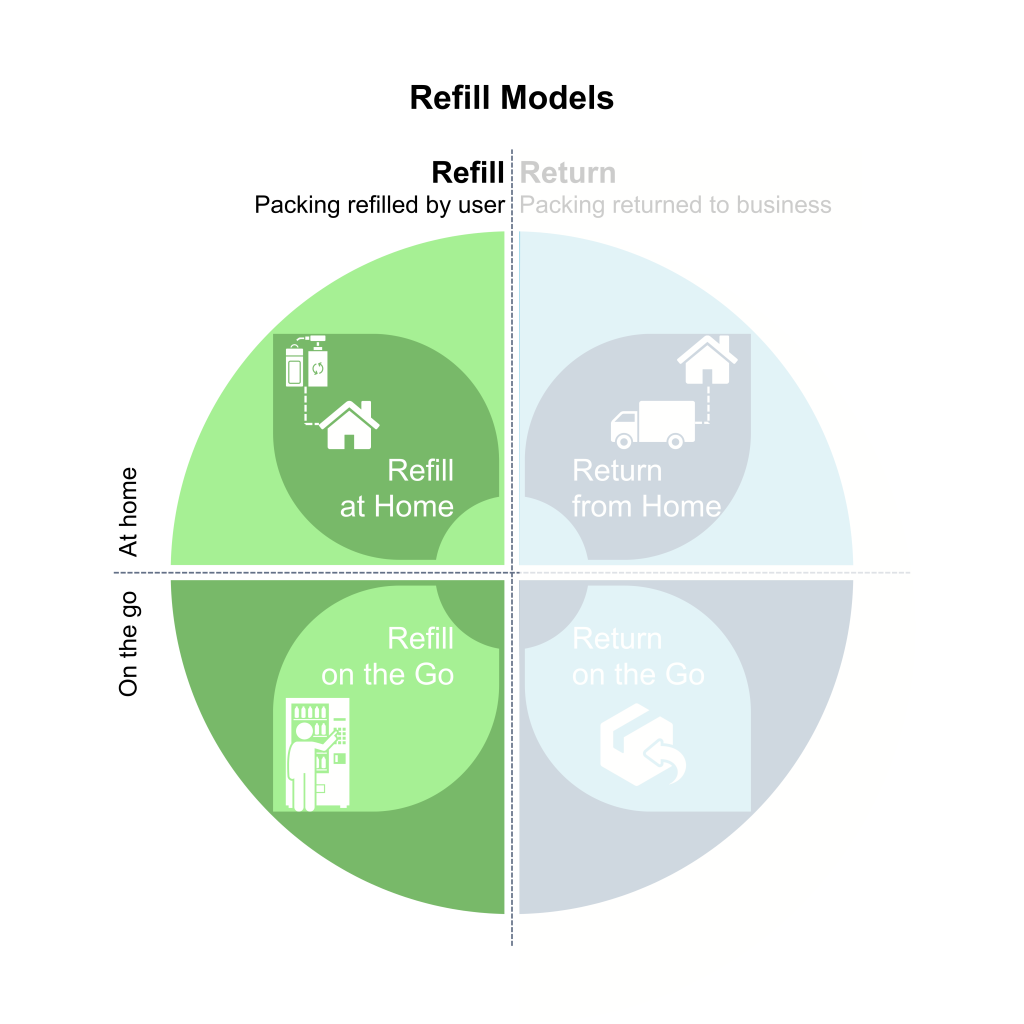
Refill systems can be implemented at home or on the go for a variety of products. These systems rely on active consumer participation and are often used to build brand loyalty while at the same time promoting sustainable consumption.
|
The history of refill The concept of refill is far from new. Long before the rise of single-use packaging and mass consumerism, many cultures around the world practiced refill systems as part of daily life. These traditional practices were born out of necessity, thrift, and respect for resources – values that modern refill solutions are rediscovering in our fight against waste and climate change. Examples from around the globe include: · In India, families would take metal tins or cloth bags to buy rice, flour, lentils, or oil from the local corner store. · In Mexico, people bought tortillas in cloth napkins or took their own jars to fill liquids. · In rural Europe, everything from vinegar to beer was sold in refillable jugs or growlers. · In East Asia, the concept of bento boxes meant containers were filled, washed, and reused daily, often for generations. · In African and Middle Eastern cultures, reusable clay pots or metal canisters were used to store and transport food and liquids. |
Refill at home:
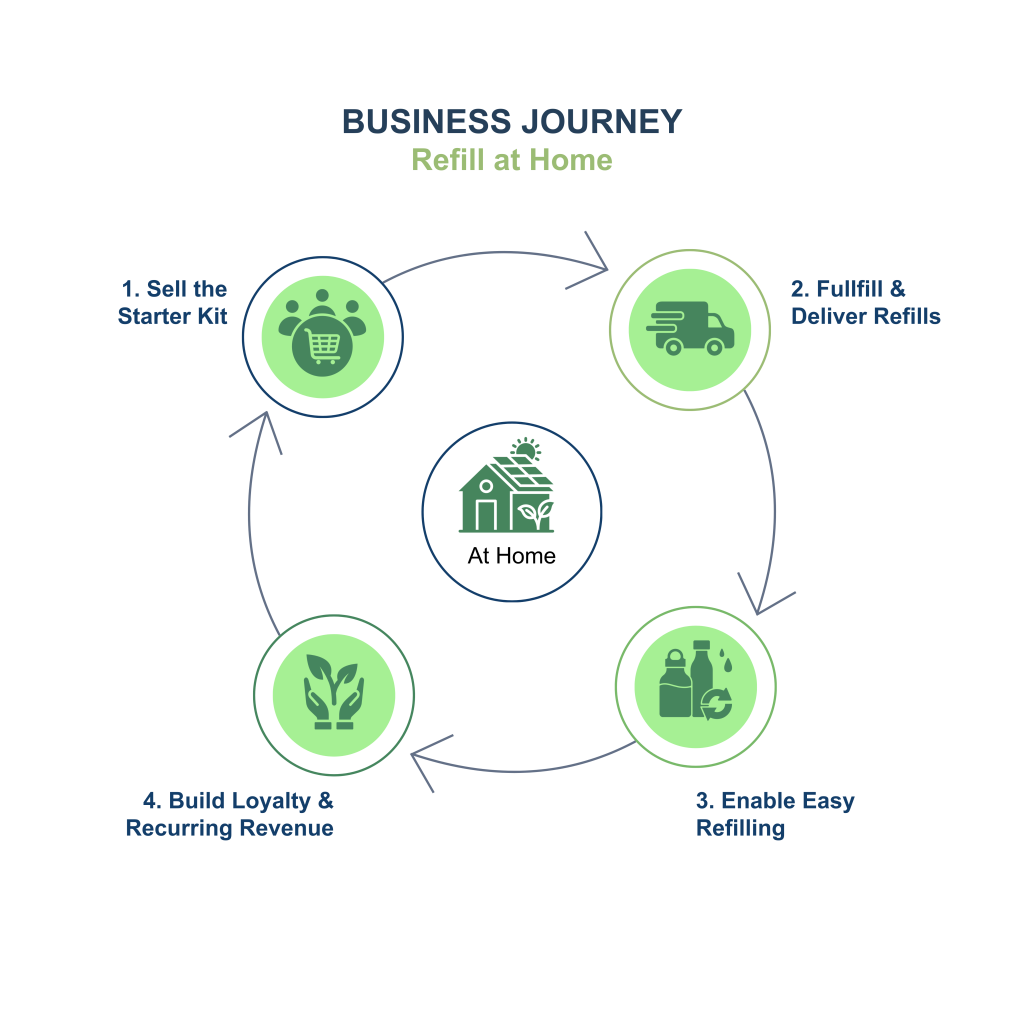 Refill at home can be used in both online and in-store shopping contexts. It has been proven as being very effective especially in the online space, by enabling a streamlined offering for users.
How it works for you:
- You sell: Customers either buy durable containers plus your product initially, or bring their own container (BYO/BYOC)
- They consume: Customers use up contents at home
- You deliver: Send lightweight refills (concentrates, tablets, refill packs)
- They refill: Customers mix or refill at home
- Repeat: Build recurring revenue through subscriptions
Real examples for inspiration:
Japan’s 50-Year Refill Culture – Kao Corporation
Japan pioneered refills during the 1970s oil crisis and now refill pouches cost ¥150 ($1) less than original packaging. Kao’s Smart Holder system uses specialized pouches that prevent air contamination, eliminating the need to wash containers between refills. Major retail chains dedicate entire aisles to refill options – it’s completely normal consumer behavior. Learn more about Kao in this recent report.
What you can learn: Simple pouch design, clear cost savings, integration with existing retail.
At-Home Beverage Solutions – SodaStream
SodaStream provides hardware that allows customers to make carbonated drinks at home. Consumers purchase a reusable machine along with carbonating gas cylinders, then create sparkling water or flavored beverages on demand. By eliminating single-use bottles, SodaStream builds brand loyalty while promoting convenience and sustainability.
What you can learn: Combine durable hardware with consumable refills, emphasize user convenience, and frame sustainability as part of everyday lifestyle.
Refill on the go:
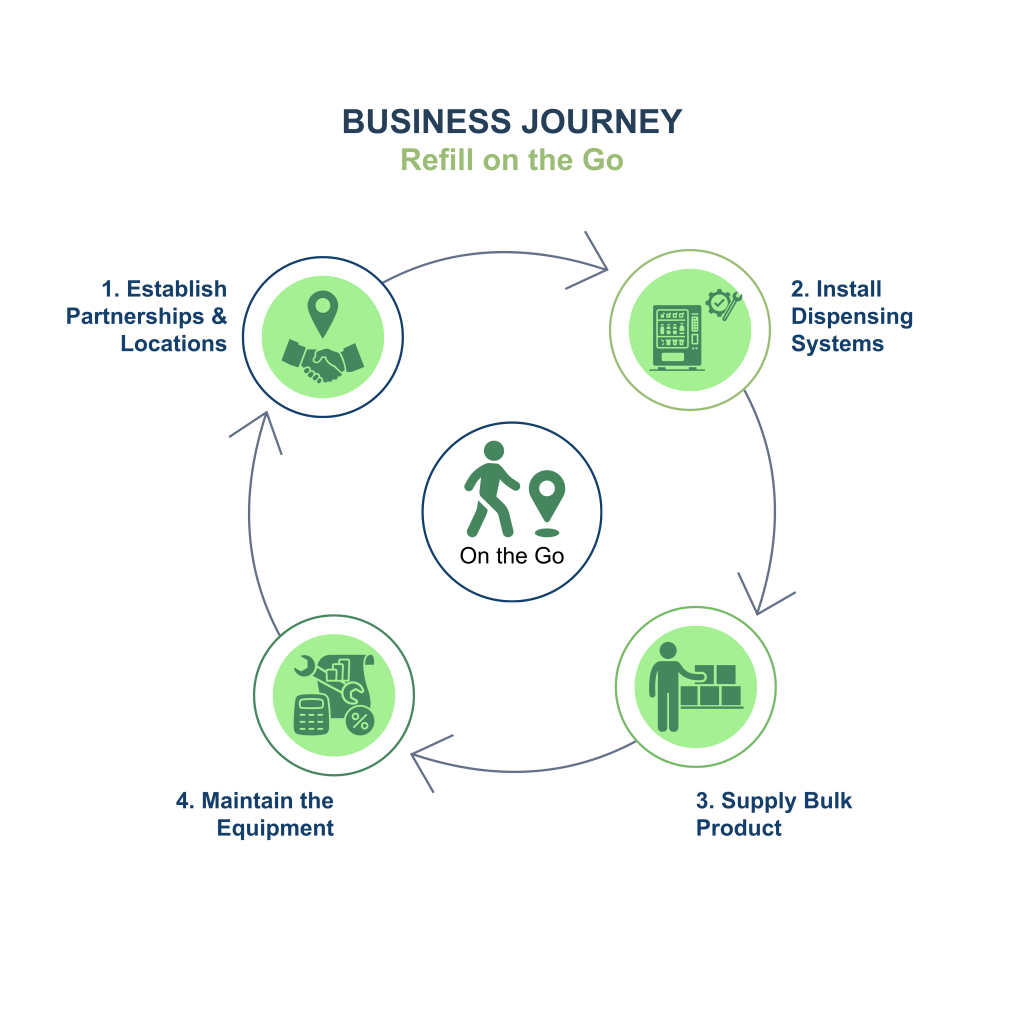
To address the needs of users looking to purchase products using their own containers while they are outside the home, refill on the go solutions are a great option. These models require a physical store or dispensing point to sell products, making it better suited to traditional retail stores and urban environments. One additional benefit of the refill models is that they allow for smaller purchases at affordable prices. This is especially beneficial in lower-income communities where it can meet the customer’s needs and budget, helping to replace the more harmful single-use sachet option.
How it works for you:
- You install: Place bulk dispensing systems in partner stores or locations
- You supply: Keep dispensers stocked with your bulk products
- Customers bring containers: They arrive with bottles, jars, or rent containers on-site
- They fill and pay: Choose products and quantities, pay by weight or volume
- They wash and maintain containers: Customers are responsible for the cleaning and maintenance of containers to be refilled.
- You maintain: Refill, clean, and service the dispensing equipment to ensure hygiene and functionality.
Real examples for inspiration: from large scale retailers to small local shops, refill can be anywhere!
Albert Heijn «Packaging Free» (Netherlands) – Major Retail Integration
In 2022, Albert Heijn, the Netherlands’ largest supermarket chain, piloted “packaging free” aisles equipped with smart dispensers offering over 70 staple products across six meters of store space per location. The initiative received attention as a bold step towards mainstreaming refill within the grocery sector. While the retailer initially announced plans to expand to 50+ stores, progress has been slower than expected. Reports suggest that operational complexity and customer adoption barriers have limited growth so far, underscoring the practical challenges of scaling refill systems in a large-scale retail environment. Nevertheless, the program provides valuable lessons: for refill to succeed in supermarkets, it must integrate seamlessly into existing shopping routines while offering clear benefits to both retailer and customer.
What you can learn: Start with pilot locations, offer wide product variety, integrate with existing retail operations
Smartfill (Bangladesh and Kenya) – Low-Cost Solutions
Smartfill developed $50 smart dispensers with Unilever targeting consumers transitioning from sachets to refillables. Cloud-based monitoring enables operation in informal retail environments.
What you can learn: Keep technology simple and affordable, work with informal retailers, target sachet replacement
Ecover – eco-friendly Brand driving refill
Ecover, a brand known for its environmentally friendly cleaning products, has implemented a refill system for many of its products like dishwashing liquid, laundry detergent, and all-purpose cleaner. Ecover has partnered with retail stores and refill stations where customers can bring their own containers or use provided containers to refill cleaning supplies directly from dispensers. In addition to refilling, Ecover products are made from biodegradable ingredients, further supporting their commitment to sustainability.
What you can learn: Leverage your brand’s commitment to environmentally friendly offerings to further increase impact!
Wala Usik in the Barangays
Sari-sari or neighborhood stores are the go-to for most Filipinos for their daily necessities, but they also have a major problem as most products sold in these stores are packaged in plastic sachets. Read about how a movement is taking place in the Philippines to convert these shops to Wala Usik zero waste shops.
What you can learn: refill can support traditional shops to reduce waste while continuing to serve local communities.
Refill mapping: Find a refill store near you!
A refill directory was created for the USA & Canada to help easily find a refill store nearby: Refill Directory
Product
Before we dive any further into the refill model, you will need to determine what type of product you want to dispense. Refill suitability depends on several factors including packaging stability, shelf life, hygiene, transportability, and user convenience. For liquids, viscosity also plays a role, as not all liquids flow the same. If you plan to dispense liquids you will want to test in different environments (temperatures, etc) to ensure consistency. For refill systems using liquids, consider how viscosity and temperature affect flow rate and hygiene.
If you are just getting started, check out the suggested product categories as entry points. Choosing a product with minimal regulation, long shelf life, and low risk of contamination will make the transition into refillables smoother and more scalable. As consumer comfort grows, you can always expand into more complex categories.
|
What is viscosity? According to Wikipedia, Viscosity is the physical property of a fluid that describes its resistance to flow. In simple terms, low-viscosity liquids are “thin” and flow easily (like water), while high-viscosity liquids are “thick” and flow slowly (like syrup or lotion).
Why it matters for refill: When dispensing liquids from refill systems, viscosity directly affects how products flow through a dispenser and how easily they can be measured. Liquids may also change viscosity depending on temperature (e.g., lotion becomes thinner in warm conditions).
Examples:
|
Deep Dive: Product Types Most Suitable for Refill
Refill suitability depends on several product characteristics including packaging stability, shelf life, hygiene, transportability, and user convenience. Certain categories stand out as particularly well-positioned for refill systems:
|
Type
|
Examples |
Personal Care ProductsThese products are used regularly, are often sold in plastic packaging, and have a stable shelf life. Many consumers are already accustomed to buying them in bulk or reusing containers.
|
· Liquid soaps · Body wash · Shampoos and conditioners · Deodorant (stick or cream-based) · Lotions
|
Cleaning SuppliesCleaning products are ideal for refill because they are used in predictable quantities, easily transported in concentrates or bulk formats and often over-packaged in single-use plastic. These are also staple products that often only come in bulk thereby adding a “poverty tax” to low-income families who can only afford to purchase small amounts. |
· All-purpose surface cleaners · Laundry detergents · Dishwashing liquids |
Dry Food and Pantry StaplesDry goods lend themselves well to refill due to low perishability and ease of storage. They often have minimal packaging requirements, making them ideal for simple bulk dispensers. Some food items also have a high refill rate, where consumers buy small amounts on a frequent basis.
|
· Rice · Pasta · Grains · Nuts
|
Liquid food and staplesCertain liquid staples, such as edible oils, vinegar, or sauces, have long shelf lives and are relatively straightforward to manage in refill systems. These are high-frequency purchase items with strong refill potential.
|
· Edible oils (sunflower, olive, etc.) · Milk / juice · Vinegar · Honey
Note: Fresh liquids such as milk are less suitable for refill in most contexts due to strict food safety, temperature control, and hygiene requirements. These are better handled in closed-loop or returnable packaging systems rather than open in-store dispensing.
|
Pet CarePet care products are purchased regularly, often come in bulky single-use packaging, and align well with the growing interest in sustainable living. Refills can make these everyday essentials more affordable and eco-friendly.
|
· Dry pet food (kibble) · Cat litter · Litter deodorizers · Treats
|
What Types of Refill Options Might You Consider?
Refill and reuse models vary widely, from at-home refill setups to refill stations on the go. Plastic IQ’s recent research provides valuable insights into different reuse systems, highlighting their potential to reduce plastic waste and meet diverse customer needs.
Technology
Hardware and Software Options for Refill Systems
The hardware and software requirements of a refill system vary depending on the product type, customer needs, data tracking goals, and budget constraints. For example, a bulk liquid dispenser may require sensors and scales integrated with software to measure exact quantities dispensed and automate payment by weight. Meanwhile, a dry goods dispenser might use RFID tags and a linked inventory management system to track consumption and trigger restocking alerts. Software platforms often include user interfaces for customers, inventory dashboards for retailers, and analytics tools for optimizing operations.
What you can learn: Tailor your hardware and software setup to fit your product’s characteristics and business goals, ensuring seamless user experience, accurate data collection, and efficient operations.
Dispensing hardware Dispensing Hardware for Refill Systems
Dispensing hardware is a critical component that varies based on the product type (e.g., dry goods, liquid oils, personal care) and context of use (on the go vs. at home). The choice of dispenser is largely dictated by product characteristics rather than customer preference, so it’s important to match hardware to your specific needs.
Not all refill models need to be high-tech! Low-tech dispensers can be effective in rural or price-sensitive markets, focusing on affordability and simplicity, while urban or large-brand contexts may require advanced, data-integrated solutions to meet regulatory and operational demands.
Examples:
|
Type |
Description |
Product fit |
Software |
Cost Level |
Pros |
Cons |
|
Manual Gravity-fed |
Uses gravity for dispensing bulk dry goods into containers |
Rice, grains, nuts, pasta |
None |
Low |
Simple, inexpensive, easy to clean |
Limited portion control, not for liquids |
|
Pump Dispensers |
Mechanically pumps precise liquid amounts via tubing/gears |
Oils, vinegar, shampoos, liquid detergents |
Usually none |
Low-Medium |
Hygienic, handles viscous liquids |
Maintenance-heavy for thick liquids |
|
Volumetric/Piston Fillers |
Accurate dispensing of viscous products using pistons |
Honey, lotions, creams |
Rare |
High |
High accuracy, food-safe |
Requires cleaning, sanitation |
|
Flow Meter-based |
Sensor-controlled dispensing (volume or mass flow meters) |
Variable viscosity liquids |
Yes |
High |
Very precise, programmable |
Needs power, maintenance |
|
Touchless/Smart Dispensers |
Sensor-triggered with IoT integration for hygiene and data tracking |
Soaps, sanitizers, subscription models |
Yes |
High |
Hygienic, easy to use, data tracking |
Requires software updates |
Software for Refill Systems
Many hardware dispensing machines also come with integrated software (apps or platforms) that enable data tracking. This data helps you better understand customer behavior and improve efficiency in stock replenishment. While software integration can be very beneficial, it also has some trade-offs: higher costs, and potential user adoption barriers, as apps may require more steps from customers, which can discourage participation.
Note: Since each dispenser typically comes with its own embedded software, there usually isn’t a need for a separate software directory platform. Instead, focus on comparing software features offered by different hardware providers.
What technology might you consider?
Depending on your business model and specific needs, here are some technology aspects to keep in mind:
- Logistics and Supply Chain Tech: These systems help manage the distribution, return, cleaning, and refilling of packaging. They are especially important for closed-loop or subscription models where packaging cycles in your supply chain.
- Dispensing Technology: Automated or manual in-store dispensers equipped with precise dosing, hygiene controls, and user interfaces for ease and safety.
- Smart Packaging (Add-on feature): If you require customers to bring their own containers, consider offering durable and reusable packaging equipped with QR codes or RFID tags. These aid in tracking usage, enhancing customer engagement through loyalty programs, and simplifying container identification.
- Container Recognition: Use QR codes, barcodes, or RFID scanners to identify containers, log refills, and link purchases directly to user accounts.
- Weighing & Payment Integration: Use QR codes, barcodes, or RFID scanners to identify containers, log refills, and link purchases directly to user accounts.
- Digital / e-commerce Platforms (also discussed in Chapter 2): Apps or web portals that enable managing subscriptions, tracking usage, ordering refills, or educating users on sustainable consumption.
- Customer Data Platforms: These platforms manage customer preferences, track refill frequency, and support personalized refill offerings based on behavior.
Packaging Types
There several packaging types for refill models that you need to take into consideration. When thinking about packaging, you also must consider safety, consumer convenience, and other key aspects which we will cover in more detail later.
User Packaging Options for Refill Systems
- Bring Your Own (BYOC)- You encourage customers to bring their own bottles, jars, or containers to fill products by weight or volume.
-
- Benefit: Customers are responsible for the maintenance, washing, and safety measures of the containers they use to refill your product.
- Challenge: Ensuring consumers remember to bring their own packaging, and that it is easily used with your weighing machines / dispensers.
- Specific packaging (provided by the system) Here, you sell or provide a specific reusable package designed for each product refill. This packaging stays with the user after purchase and refilling, they are responsible for maintaining and reusing it. Often the first package is given free or at a low cost to encourage trial; afterward, customers pay for replacement packaging.
- In many cases, businesses offer the first package for free or at a low cost to encourage adoption; afterward, the user pays for and keeps their refillable packaging.
-
- benefit: The standardized packaging should be easy to use into your system.
- negative: Users are limited to using only your packaging and must remember to bring this with them. Businesses also need to invest upfront to produce these packages, and there may be ongoing user responsibility for maintenance/upkeep. You bear the upfront cost of producing these packages and need to manage sales alongside refill dispensing. Users also have ongoing responsibility for maintenance and upkeeping.
How is This Different from Returnable Packaging?
Returnable packaging requires customers to return the empty container after use so the business can clean, sanitize, and refill it for future customers, this is a true “closed-loop” system. In contrast, specific packaging for refill remains with the user as long as they continue to refill it themselves.
In many models, businesses provide the first refillable container free or discounted for trial periods, then switch to charging customers for replacement or additional packages. This differs from return systems, where customers usually pay deposits refundable upon return
B2B packaging
This bulk packaging supplies the product within your refill machines and directly serves consumers. It must be designed for efficient transport, storage, and seamless integration with your dispensing equipment. Materials and formats should protect product quality, be easy for staff to handle, and minimize waste during product changeovers.
- Benefit: Larger-format B2B packaging reduces the frequency of replenishment, lowers transport and packaging costs per unit of product, and can be designed for reuse within your supply chain (e.g., returnable drums, totes, or bulk bins).
- Challenge: If not designed for reuse, B2B packaging can become a significant source of waste. Reusable bulk formats require a reverse logistics system for collection, cleaning, and inspection, as well as staff training to handle them safely. Compatibility between your B2B packaging and different dispenser types is also critical to avoid leakage, contamination, or operational downtime. In addition, local regulations on manual handling often limit the maximum weight a person can lift, commonly around 20–25 kg, so exceeding this threshold would require alternative replenishment methods such as pump systems, gravity-fed hoppers, or mechanical lifts. This should be factored into the B2B packaging design from the start.
|
Example: The Body Shop’s Global Refill Station Pilot
The Body Shop piloted a global refill scheme across 720 stores using their own bulk packaging integrated with refill stations. Their system is designed for easy setup and user-friendly customer experience, serving as a practical model for larger-scale refill implementation.
|
Open fill or closed fill system
You will need to determine if your refill system operates using an open or closed fill system. What does this mean?
Open fill: The container is opened and manually filled (not connected to the dispenser) either by the consumer or a store associate. Cheaper and easier than closed fill. This is the most common option.
Characteristics:
- Manual Handling: The container is opened, exposing the contents to the air.
- Consumer-Controlled: Often used in self-serve or bulk store settings.
- Lower Tech, Lower Cost: Minimal equipment; simple dispensers.
- Higher Risk: Greater potential for contamination, spillage, or incorrect dosage.
Main use: Bulk food and other non-liquid items.
Closed fill: Where the product is transferred in a closed environment, that does not expose it to the environment. This helps solve messiness and safety issues which can be barriers for customer adoption.
Characteristics:
- No Direct Exposure: Container remains sealed or semi-sealed during refill.
- Precision & Safety: Ensures dosing accuracy and prevents contamination.
- Higher Tech, Higher Investment: Requires specialized packaging or dispensing equipment.
- Brand-Controlled: Often part of a closed-loop, branded system.
Main use: liquids – helps avoid leakage issues and also mitigates spoilage such as rancidity of oil due to oxygen exposure.
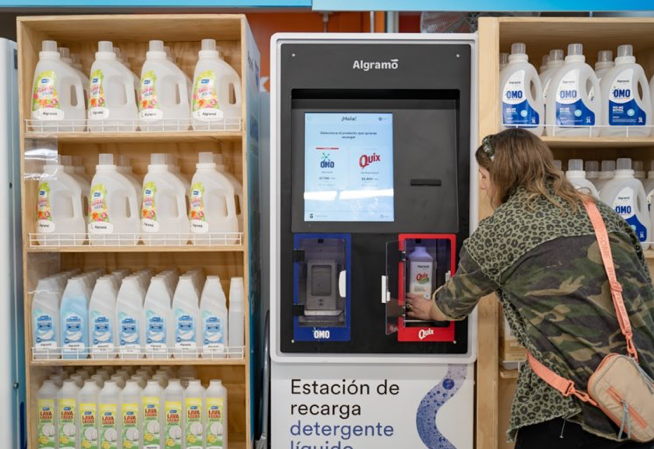
Algramo Refill station in Chile: Photocredit Algramo
Spotlight: Ecourage:
Ecourage is a Norwegian tech-forward company, that develops innovative smart refill systems aimed at reducing plastic waste and enhancing consumer engagement. Their solution integrates reusable packaging with an NFC-enabled “OmniCap”, facilitating a seamless, mess-free refill experience. Consumers can simply bring back empty containers, which the system recognizes and accurately dispenses the right volume while personalizing the interaction and tracking usage—boosting brand loyalty, enabling supply chain efficiencies, and supporting sustainability goals.
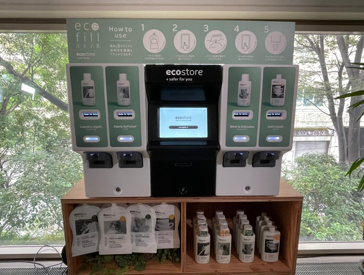
Image of Ecourage vending machine. Photo credit: Ecourage
Social Business Perspectives in Reuse ModelsReuse models not only offer environmental benefits but also align deeply with social business principles, prioritizing social impact alongside financial sustainability. Many initiatives supported by Yunus Environment Hub demonstrate how reuse systems can promote a just transition, create green jobs, and empower communities with sustainable livelihoods. Integrating social business approaches means designing reuse solutions that balance environmental goals with social inclusivity, affordability, and local economic development. Throughout this platform, you will find case studies, tools, and insights showcasing these social business models and emphasizing their role as catalysts for circular economies and inclusive growth. Below are some examples of YEH social business alumni driving circular and socially inclusive reuse models (both refill and return) around the globe: · 3R Solutions (India) – Leveraging its patented cleaning technology, 3R Solutions recovers used plastic containers and reconditions them for reuse for the paints, lubricants, and allied industries. · EcoTrace (Kenya – initiative from Mount Kenya University). Mobile and stationary refill stations providing affordable consumer essentials without plastic packaging, recently partnered with Unilever to scale impact. · Spex (Ghana): Online meal marketplace and delivery platform providing reusable packaging to restaurants and vendors, empowering women entrepreneurs and reducing plastic waste. · Salin Swap (Philippines): Provider of reusable containers with smart tracking to eliminate single-use plastic in daily consumer goods distribution. · iRefill (India): Smart refill dispensers offering FMCG products like grains, edible oils, dairy, and personal & home care items, utilizing IoT technology to reduce single-use plastics. · Bottle Logistics (Kenya) Works with registered food and beverage companies to build a sophisticated and sustainable returnable system for their reusable glass bottles. · Ocean Package (Germany) A reusable shipping box system integrating smart technology and recycled materials to replace single-use cardboard packaging with a more environmentally friendly, circular alternative. These social businesses demonstrate how reuse solutions can be economic empowerment tools, environmental protectors, and drivers of systemic change. Their work complements YEH’s mission to build resilient, inclusive circular economies worldwide. |
|
Intro to Algramo Algramo started in 2013 in Santiago, Chile, with a simple but powerful mission: to end the so-called “poverty tax” that low-income families pay when buying products in small, single-use packages. In many neighborhoods, the smallest packages have the highest cost per gram or liter, making essential goods disproportionately expensive for those who can least afford them.
From day one, they implemented a returnable packaging system under their own Algramo brand, selling detergents, dishwashing liquids, fabric softeners, and floor cleaners in reusable containers. This model scaled to more than 5,000 neighborhood stores across Santiago, helping families save money while avoiding thousands of tons of single-use packaging waste.
In parallel, they developed smart dispensing systems for major brands, incorporating intelligent packaging that connected to mobile payments and loyalty programs. This allowed consumers to conveniently refill brand-name products while tracking their environmental savings. The combination of their own large-scale returnable brand and technology partnerships demonstrated that reuse can succeed across multiple product categories and business models, if it’s designed to work for both people and the planet. |
Benefits and Challenges of Refill Models
Yet while refill models bring many benefits to the environment, society, and directly to users of the model, they also face challenges that must be addressed to successfully scale. The table below outlines some key advantages and obstacles to help you understand the reality of implementing a refill initiative or business.
|
Benefits ● Improve brand loyalty, sales and customer satisfaction through subscriptions and automated reordering. ● Users benefit from the convenience of receiving products at home while lowering their environmental impact. ● Businesses using smart dispensers can gain insights on users and capture relevant data on preferences. They can also predict when to refill stock to avoid product wastage. ● Businesses can improve revenues by saving costs related to transportation and packaging. ● Consumers can select exact quantities based on needs and budget. ● Offer an environmentally friendly product offering for consumers and businesses who are looking to reduce their footprints. ● Opportunities for brands and retailers for consumer-loyalty development, through lengthened product engagement. |
Challenges ● Helping shift consumer behaviour (ie: from pre-made to concentrate format, proactively choose refill dispensers vs standard packaging). It can be very challenging to motivate users! ● Costs for refill models are very often still high compared to single use packaging offers. Regulations are coming in to offset this, however every country/community faces different realities and price sensitivity may be a challenge. ● Refill systems must be easy to use, meet all product safety regulations and standards, and convenient for users. The experience must be positive if you want to guarantee a steady (and growing) user base. ● Too much tech could be a barrier for use (ie: downloading apps, open accounts, etc)
|
Note: To truly reduce packaging waste, ensure your refill packaging is reusable, recyclable, or compostable.
|
Inspiration: Unsuccess story
Unfortunately, not all businesses succeed. For candid lessons on pitfalls to avoid, check out Dizzie’s story — a reminder that not all reuse companies succeed without careful planning: Dizzie’s journey. An examination of the business Dizzie… | by Dizzie | Medium |
More examples for inspiration:
- Reuse and Refill business model – article with focus on Asia
- Example of national reuse initiatives from Circular Economy Malta
- Learnings from Unilever’s reuse pilots