

Chapter 3: Go to Market Strategy
Chapter Expectations
- Different elements of the strategy
- Relevance of consumer behaviour
- Incentives (Carrots or sticks?)
- Coordination with POS and Brands
Introduction to go-to-market strategy
A go-to-market (GTM) strategy is an essential plan that help you outline how to launch a product or service to market, reach target customers, and achieve competitive advantage.This chapter will cover key elements to a successful strategy, including how to identify your target market and ensure an attractive product offering and value proposition to help secure sales and potential partnerships and collaborations you could leverage. You will also have insights on different business models you could consider, based on your target audience.
Understanding the refill viability
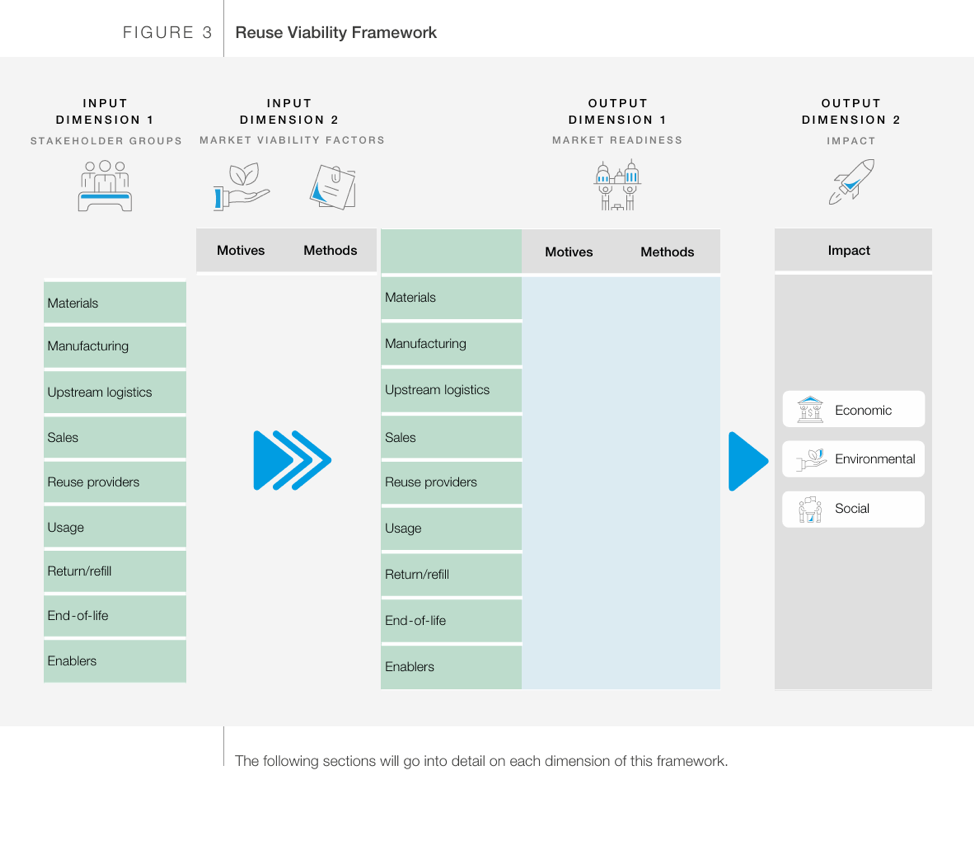
Target market identification
This step can look different depending on your context:
- If you are an established brand, you may already know your product line and now need to evaluate which markets or customer groups are best suited for a reuse or refill model.
- If you are an entrepreneur, you may still be shaping your product concept and therefore need to define your target market alongside product development.
- In some cases, the starting point is the Point of Sale (PoS) or business channel (e.g. cafés, retailers, delivery), and you then evaluate which products, margins, and consumer segments make the most sense within that channel.
Are you selling to other businesses through a B2B model, or directly to individual consumers users through a B2C model? What motivates them? Are they driven by cost savings, convenience, sustainability, or compliance with regulations? Understanding these drivers will help you refine your offer and communication strategy.
- Identify the Problem you are solving
What is the pain point or need your offering addresses? For refill solutions, this might include compliance to regulations, consumer desire to reduce their own environmental footprint amongst many others.
- Segment your Market
Who are you trying to reach? Break down the broader market into specific segments based on:
- Demographics: Age, gender, income, education. Who is your target audience/user?
- Psychographics: What are their values, lifestyles, attitudes (e.g., eco-conscious consumers, zero-waste advocates).
- Behavioral Traits: Shopping habits, brand loyalty, usage frequency (e.g., frequent users of household cleaning products).
- Geographic Location: Where does your target market live? Urban vs. rural environments.
- Analyze Needs and Motivations
Dig deeper into why certain target customers or consumers would adopt your refill solution. Are they driven by sustainability, cost savings, compliance, other? Are they early adopters or need more convincing through education and incentives? Is refill already the “norm” or is this a new concept?
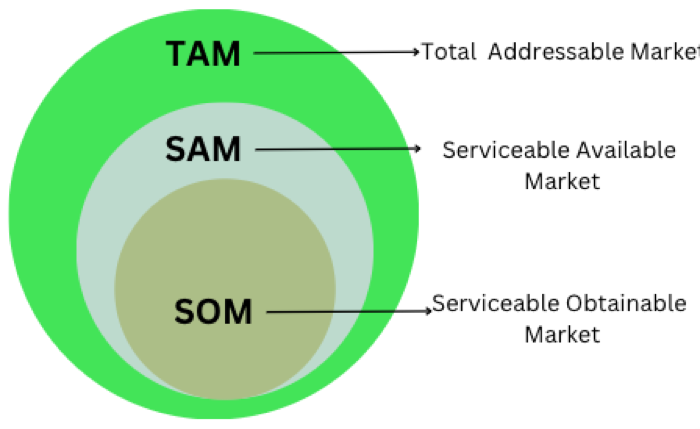
- Evaluate Market Size & Accessibility
Assess whether your chosen segment is:
- Large enough to justify marketing spend to drive sales.
- Accessible through the channels you plan to use (online, retail, events).
- Ready to engage with the refill concept (open to behavior change, value sustainability).
Include TAM, SAM, SOM here? (create own visual if yes)
- Create Buyer Personas
Develop 2–3 detailed customer profiles that represent your ideal users so you can have them in mind when developing your GTM plane.
Example personas for B2B business could include;
- Sustainability-Driven Store Owner: An Independent Organic Market selling natural food & wellness store in an urban area.
- Chain Retail Sustainability Lead: A Regional Sustainability Manager at a Mid-Size Grocery Chain with around 50 regional stores.
- Community Hub Operator: Director of Operations at a University or Co-Working Space
If you are a B2C business your personas may look like:
- Eco Emma: A 32-year-old urban professional who shops organic and wants plastic-free options.
- Budget Ben: A price-sensitive dad who’s open to refills if they save money long-term.
- Minimalist Maya: A design-conscious shopper looking for elegant, reusable packaging.
Defining your target audience sets the foundation for tailored messaging, product design, distribution channels, and promotional tactics that resonate and drive adoption. It will also help understand what technical capabilities your solution should offer based on user needs.
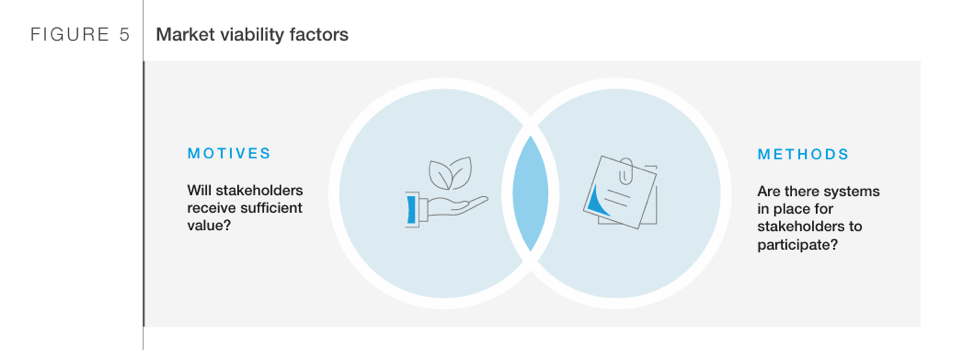
Market viability and readiness? Include? Example
|
Check out this recent case study based on the real experience trying to get communities onboard with refill Getting communities into the Refill Rhythm by RosieHornbuckle – Issuu |
Product offering & value proposition
What product you will offer in your refill solution is key to many decisions you will make. Key elements related to your product offering to consider include:
- Product offering: what will you sell
- Location: rural or urban, at home or in store
- Market size: population of area to install
- Convenience: how easy it is for them
- Price: is this a high end or low-end offering
- Technology: will you offer products using a tech enabled dispenser
- Packaging: will customers bring their own, or will you offer yours
- Brand: will you sell a known brand or a white label brand
You will also need to determine roles and responsibilities for each area to ensure a smooth flow. You may outsource some areas to experts, others you may manage in-house.
The product offering and value proposition will differ by target audience. High-end retailers may want to associate their products with high tech, cool, tech-enabled refill solutions that offer data on packaging saved, specific consumer profiles, etc while a small mom-pop shop in a rural area may only require a low-tech option that allows easy and safe dispensing of products. How you describe your value proposition to gain clients and end-users will vary therefore based on the target audience, but here are a few key areas to keep in mind.
Refill solutions offer consumers a more sustainable alternative to traditional single-use packaging by enabling them to replenish products—such as household cleaners, personal care items, food, etc—using reusable containers. But this is not enough to convince people to use refill models!
The value proposition for refill will differ based on your target market. For B2B offers, you might want to focus on eliminating unnecessary packaging waste. Helping these customers understand the potential of refill to reduce Co2 emissions and plastic waste diverted from landfill could be a strong driver as they prepare for compliance to upcoming regulations. As more and more regulations are coming into place related to packaging such as the EU regulation on PPWR and the global plastics treaty, the shift to reuse should come sooner rather than later! For developing countries or more rural locations cost might be the biggest driver, therefore speaking to how refill can increase efficiencies and reduce overall costs would be key.
The refill value proposition for retailers and brands could includeh innovative packaging formats (e.g., refill pouches, concentrates, or bulk dispensers) which allows customers to buy the exact amount of product they want. For example, Sonke in South Africa who builds automated Refill Stations for brands and retailers that “save money and the planet”. Sonke clearly outlines the benefits for both end users and retailers on their website
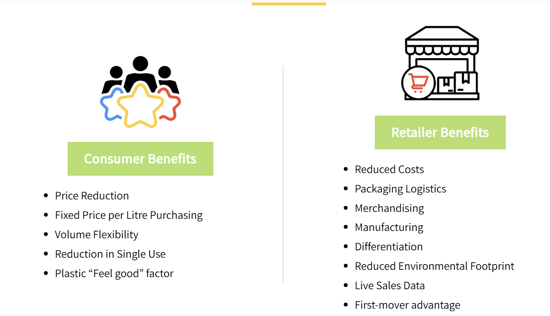
The value proposition can also help brands and retailers by associating consumer use of their brand with a positive environmental impact. For example, Algramo in Chile has made refill attractive and trendy through campaigns that link affordability with sustainability, such as their mobile refill tricycles and app-based loyalty rewards that resonate with younger, eco-conscious consumers.
For B2C models, it is important to remember that people buy products for physical, emotional, financial, and lifestyle-related reasons. Your refill value proposition should therefore be a combination of functionality, convenience, cost, variety, and desirability. Take another look at the Sonke example for inspiration. Depending on your target customer, the main focus will vary.
Get a better understanding of your customers through data Insights. Access user behavior, refill frequency, and popular products for improved business planning.
Ultimately, to convince the adoption of refill solutions, we must also address an essential element that drives action: cost. Refill may have a larger upfront cost for retailers or brands, as we need to implement new systems, but it has the potential to lower long-term costs. Consumers will need to play a more active role by bringing containers to refill or returning packaging for cleaning. However, in the end, this approach should offer a more economical solution, especially for those from lower-income communities who cannot afford to purchase items in large quantities. Pricing models can increase consumer action by rewarding repeated use (such as lower unit costs or subscription savings).
|
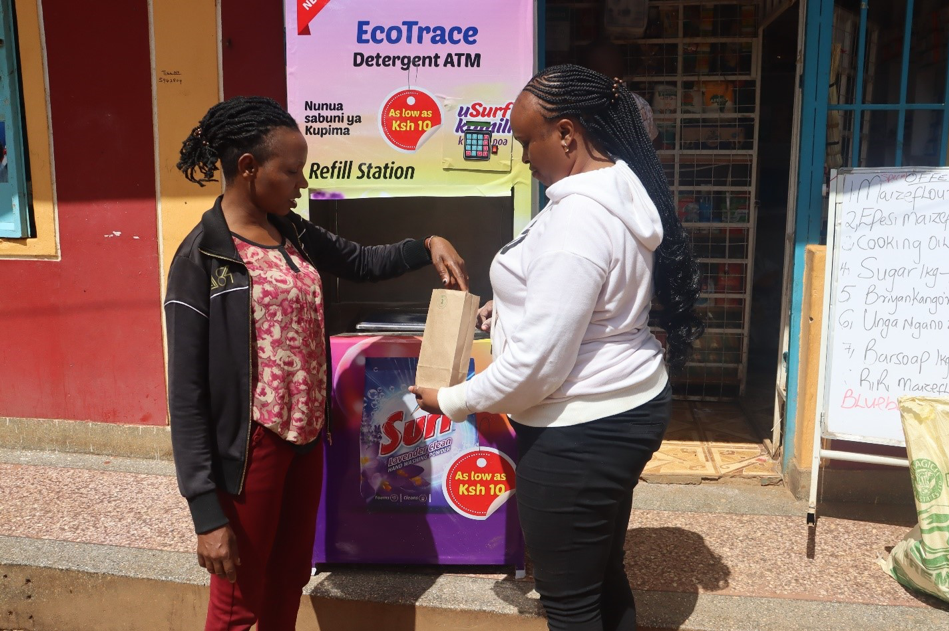
Call out box: The story behind EcoTrace Kenya is one of the leading African countries for policies related to plastic usage. In 2020 Kenya banned the use of all single-use plastics (SUPs) in all protected areas and developed a complementary implementation plan, including outreach campaigns and financial disincentives (such as fees) on SUPs, as noted in a policy brief by the Duke Nicholas Institute for Environmental Policy Solutions. Kenya was also amongst the first countries to ban plastic bags. However, the plastic waste challenge still exists, and is expected to get worse: by 2060, plastic generation is expected to be 1.9 million metric tons per year. While policies are needed, work on the ground is also critical to change consumer behavior and provide offerings to SuPs, for example through reuse and refill models. The value proposition for low-income communities is focused primarily on cost savings and convenience, being able to easily purchase small quantities at an affordable price. Environmental aspects are also important as often times these communities lack proper waste collection, therefore face a higher burden of waste directly where they live. In Nairobi, Kenya, EcoTrace is working to drive solutions for refill. As an alumni of the Innovate2PREVENT program implemented by Yunus Environment Hub on behalf of the PREVENT Waste Alliance, they piloted an inclusive refill system for detergents. The aim: to reduce single-use plastic packaging while high-quality powdered and liquid refills As part of the I2P program, EcoTrace developed and produced four IoT-enabled detergent refill dispensers, each designed for community-based or shop-based use. These machines were developed in partnership with local fabricators, with iterative improvements to refine usability, safety, and branding. The refill station enables low-income customers to avoid the poverty tax by accessing affordable quantities of detergent—priced similarly to bulk purchases, but without the packaging waste.
EcoTrace refill agents with a customer. Photo credit Yunus Environment Hub By aligning accessibility, affordability, and circularity, EcoTrace presents a scalable model for upstream plastic prevention supporting the global shift toward reuse infrastructure that eliminates packaging waste at the source. |
Product/Market fit
Assessing Market Readiness
Before scaling, validate your product/market fit:
- Customer Retention Rate: >60% indicates a strong fit
- Refill Frequency: Regular repeat customers
- Customer Feedback: Positive reviews and referrals
- Competition Response: Market acceptance of the refill concept
Product Selection Criteria
Choose products with:
- High turnover rates
- Significant packaging waste
- Price-sensitive customer base
- Suitable physical properties (viscosity, shelf life)
You can try different locations, PoS, and product categories provided to test which would be the best fit as part of your pilot.
The product you offer and the positioning will also depend if you want to partner or associate with a well-known brand, or use a white-label option. Both have pros and cons for each. See more in the box below, as well as in the next section on partnerships and collaborations.
|
|
Pro |
Con |
|
Brand – global |
Options for partnerships and collaborations to drive adoption / sales Customer loyalty / awareness already associated with the brand Pressure to become compliant |
Usually a more expensive product |
|
Brand – local |
|
|
|
White Label |
Cheaper product
|
Lack of customer loyalty / awareness
|
Partnerships and collaborations
Collaboration is key to driving the scale of reuse. No matter what actor you are, you can play a role in the process, here are some examples to get you thinking.
- Collaboration between Retailers for Refill Stations: Partner with grocery stores or other retail outlets to set up convenient refill points in high-traffic areas.
- Examples:
- Tesco (UK) + Loop (TerraCycle) [1]– Customers can buy products in durable, refillable packaging and return them for cleaning and reuse.
- Lotus’s Thailand piloting refill stations in collaboration with big FMCG brands.
- Collaboration with Brands for Refill Stations.
- Examples:
- Algramo provides smart reusable packaging, and Unilever products can be refilled via mobile dispensing systems. Such models can also be franchised or adapted locally by partnering with existing solutions (e.g. Vytal’s franchise system, or local refill startups in Asia).
- Unilever + Siklus (Indonesia) – delivering refill products via refill-on-wheels to households.
- Collaboration between brands and retailers
- Examples:
- Ecover + grocery stores[3] – Ecover partners with both small and large stores to sell their products. Helps with cross-promotional activities to drive awareness and action.
- NTUC FairPrice (Singapore) partnering with various FMCG brands to pilot in-store refill stations.
- Collaboration with refill providers and local suppliers (ie: social businesses, producers) to source local products. This promotes the local economy, reducing shipping packaging, and transportation emissions.
- Example: Zero Waste Saigon partnering with Vietnamese refill providers to promote local cleaning and personal care products.
- Collaboration via Multi-Brand Retail Coalitions
- Examples:
- UK Refill Coalition[4] (Marks & Spencer, Morrisons, Ocado, Waitrose) Collaborating to create standard refill infrastructure that multiple retailers and brands can use.
- RefillMyBottle network (originating in Bali, Indonesia) – coalition of cafés, hotels, and shops offering common refill points across Southeast Asia.
- Collaboration between Municipality & Refill company
- Examples from the RSVP project in 5 EU cities ReuSe Vanguard Project (RSVP) – Zero Waste Europe
- Jakarta city waste management authorities collaborating with startups like Qyos and Siklus to support refill access in low-income neighborhoods.
- Examples:
- Examples:
- Examples:
- Examples:
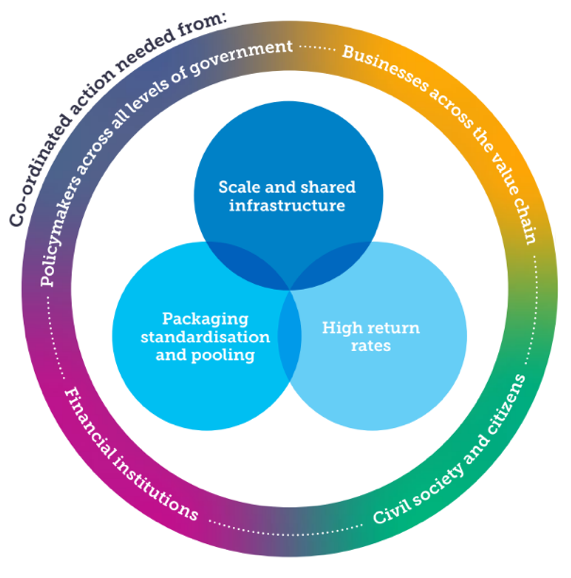
Partnerships and collaboration can unlock systemic change and drive down costs, improve efficiencies and get us to a reuse revolution much faster. Check out this detailed report from EMF to learn more Unlocking a reuse revolution: scaling returnable packaging
[2] A refill model to keep packaging out of the environment: Algramo
[4] https://www.refillcoalition.com/
Customer journey
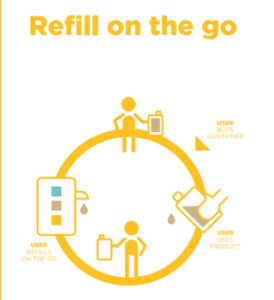
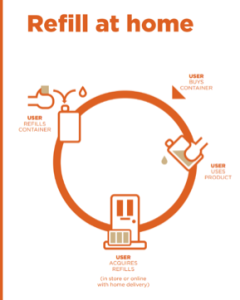
The customer journey for refill will depend on the model they use – will they refill something “at home” using a subscription service, or “on-the-go» for example, in a store? There are challenges related to customer adoption in both scenarios, but don’t worry, we will get to that in another chapter!
Below are some overarching examples of the journey for different scenarios:
Visual guide: Create a visual that lays out the journey at home and on the go. Ensure its relevant to high and low tech options. in the graphic include consumer use guide (educate customers on how to use the refill process), include incentives, apps, etc? leaving the house with the refillable container.. Door to door steps in more depth Depending on your target audience and product the journey will slightly differ (ie: Download app, not needed if low-tech, etc)
(Create our own visuals for the 2 options, as well as B2B)
Business models
What are the different business models associated with refill solutions? This will depend on your final customer and their needs. Below are some examples of models
B2B offerings offer refill solutions to their customers, who in turn sell to the final end consumer. This could be a white label brand, a proprietary brand or a mix of products. Below are a few B2B examples:
- A bulk cleaning product refill supplier for hotels, restaurants, or schools.
- A refill company that provides stations or systems (ie: to retail chains for soap, shampoo, or detergent).
B2C options sell refill products directly to the end consumer examples include:
- A closed ecosystem with refill offerings, (ie: University Campus, Stadiums, Offices etc)
- A zero-waste store where customers refill household products.
- A subscription-based service for refillable cleaning sprays or food containers.
Regardless of your offering, it can be very beneficial to clearly map out the following areas to better understand your target market:
B2B
- Hardware sales (ie: refill stations sold to a grocery outlet)
- Hardware leasing
- Bulk sales of product (ie: shampoo brand selling to a retailer to dispense to final consumer?)
- Subscription model?
- Software sales
B2C
- Subscription model
- Direct in-store sales (ie: grocery outlet selling to final customer, zero waste stores)
- Stand-alone kiosks/machines
|
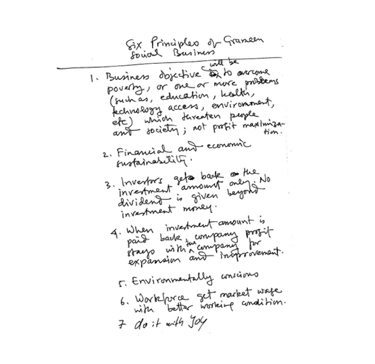
Ensuring holistic impact: a Social Business Approach Social Business is a cause-driven business. In a Social Business, the investors/owners can gradually recoup the money invested, but cannot take any dividend beyond that point. Purpose of the investment is purely to achieve one or more social objectives through the operation of the company, no personal gain is desired by the investors. The company must cover all costs and make a profit, at the same time achieve the environmental or social objective, such as providing safe drinking water, introducing renewable energy, preventing plastic pollution, reducing CO2 emission or providing health care, housing or financial services for the poor in a business way. The impact of the business on people or the environment, rather than the amount of profit made in a given period measures the success of social business. Sustainability of the company indicates that it is running as a business. The objective of the company is to achieve social goals.
Nobel Peace Prize Laureate Prof. Muhammad Yunus defines the concept of Social Business by seven principles:
1. Business objective will be to overcome poverty, or one or more problems (such as education, health, technology access, and environment) which threaten people and society; not profit maximization 2. Financial and economic sustainability 3. Investors get back their investment amount only. No dividend is given beyond investment money 4. When investment amount is paid back, company profit stays with the company for expansion and improvement 5. Gender-sensitive and environmentally conscious 6. Workforce gets market wage with better working conditions 7. Do it with joy
|
Incentives
To drive adoption for refill we need to incentivize our users. How can you drive adoption and use for refill solutions? Below are some examples to consider depending on your target customer’s motivation.
Incentives for B2C users:
- Points per Refill (redeemable for discounts or rewards)
- Tiered Loyalty Levels based on refill frequency
- Gamification (e.g., badges or challenges for number of refills)
- Referral Bonuses for getting others to participate
- Environmental Footprint tracking: Offer an app that helps users track their environmental footprint.
- User identify: Durable, stylish containers that elevate the user experience and create a symbol that users could relate to.
Incentives for Retailers / B2B Partners
- Low-Cost or Free Pilot Programs: Provide machines at a discounted rate or free for a trial period to demonstrate ROI and consumer interest.
- Bulk Purchase Discounts: Reduced pricing for ordering refill product stock in larger volumes.
- Co-Financing or Lease Options: Flexible payment plans for equipment and setup to minimize capital investment.
- Customer Loyalty: Develop customer loyalty programs for those using refill options.
- Marketing Support: Co-branded promotions, POS materials, and sustainability storytelling from refill solution providers. PR and press opportunities.
|
Share the algramo business model for refill Algramo – insights… better to focus on one part of the chain |
Activities or exercises
What is needed to move on to next chapter?
What business model are you currently implementing? What
Flow chart – product, target audience, their motivation, rural/urban.. What is the outcome? What can we map?
Where could this example go: sari-sari convenience stores in the Philippines transition to zero waste stores (Wala Usik)
Wala-Usik Sari-sari stores innovate with non-sachet products to help reduce sea waste – GoodNewsPilipinas.com